
English 
T: +86-13212036031
E: mason@easy--scaffolding.com
E: mason@easy--scaffolding.com
Room No.203, Building No.5, Huijin Plaza, West Fifth Road No.35, Tianjin Airport Economic Zone, Tianjin, China

Views: 0 Author: Site Editor Publish Time: 2026-03-10 Origin: Site


Why do skyscrapers take so long to build? Vertical work repeats many times. Delays easily appear. Traditional formwork moves often. Cranes must lift it again. This slows construction.
Self climbing formwork climbs with the structure. Work continues floor by floor.
In this article, you will learn how self climbing formwork improves skyscraper efficiency.
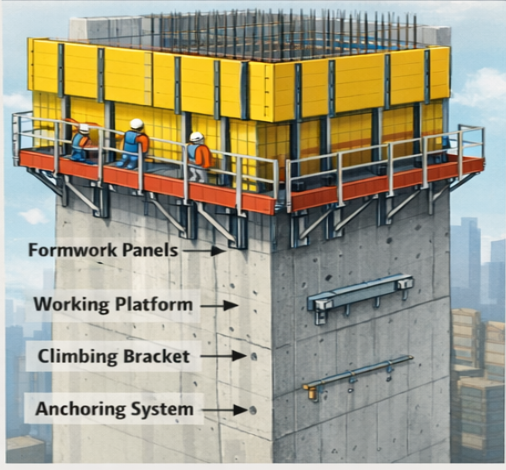
Self climbing formwork is a mechanized construction system specifically designed to support the vertical development of reinforced concrete structures. Unlike conventional formwork, which must be dismantled and repositioned repeatedly, this system is engineered to remain attached to the structure and climb upward as the building rises. By connecting to previously completed concrete segments through anchoring devices, the system forms a stable working framework that moves in stages during the construction process. This approach makes it particularly suitable for skyscrapers where vertical repetition is a dominant characteristic of the structure.
In high-rise construction, the central structural core often contains elevator shafts, stairwells, and shear walls that provide the primary lateral stability of the building. These elements are typically constructed in reinforced concrete and extend continuously from the foundation to the top floors. Self climbing formwork systems are widely used in these areas because they allow the construction team to maintain a consistent workflow while minimizing interruptions caused by dismantling traditional formwork systems.
Key structural elements typically included in a self climbing formwork system include:
● Climbing brackets that connect the system to the structure
● Anchoring devices installed in cured concrete
● Working platforms for construction personnel
● Formwork panels used for shaping concrete walls
These components work together to create a vertically movable construction environment that supports multiple tasks simultaneously. As a result, the system provides both structural support and operational workspace during the concrete construction process.
The defining feature of a self climbing formwork system is its hydraulic climbing mechanism, which allows the entire platform and formwork structure to move upward without relying on cranes for each repositioning stage. Once a concrete section has been poured and has reached sufficient strength, hydraulic devices activate and lift the system to the next construction level. This movement occurs in a controlled and synchronized manner to maintain structural stability and worker safety.
During the climbing process, anchoring components embedded in the previously completed concrete structure act as secure support points. These anchors temporarily hold the system while the hydraulic cylinders raise the platform and formwork assembly to the next level. Because the system climbs in stages rather than being completely removed and rebuilt, construction teams can maintain continuity between floors.
The simplified sequence of the hydraulic climbing operation can be illustrated as follows:
Step | Construction Action | System Function |
1 | Concrete for the current level is poured and cured | Formwork maintains wall alignment |
2 | Anchors in the cured concrete secure the system | Structural stability is maintained |
3 | Hydraulic cylinders activate | Platform and formwork are lifted |
4 | System locks into new anchoring points | Ready for the next construction cycle |
This automated movement reduces reliance on heavy lifting equipment and allows construction activities to progress more efficiently along the vertical axis of the building.
Another important feature of self climbing formwork systems is the integrated working platform, which transforms the formwork structure into a multifunctional construction workspace. Instead of operating separate platforms for reinforcement installation, inspection, and formwork preparation, the system provides a unified area where multiple tasks can be performed concurrently.
Within this platform environment, construction workers can install reinforcing steel bars, prepare formwork panels, and conduct inspections before concrete placement. Because all these tasks occur within the same operational zone, communication between teams becomes more efficient and workflow interruptions are reduced. The platform design also supports safe movement for workers and materials within the vertical construction area.
Typical activities performed on the integrated platform include:
● Reinforcement placement and tying
● Formwork alignment and adjustment
● Concrete pouring preparation
● Structural inspections and quality checks
This integrated configuration plays an important role in improving operational coordination during skyscraper construction. By consolidating work areas and reducing unnecessary movement between floors or platforms, the system supports a more organized and predictable construction process.
The installation of a self climbing formwork system usually begins during the early phases of reinforced concrete core construction. At this stage, the structural foundation and the initial sections of the building core are already completed, providing a stable base for anchoring the climbing system. Engineers and construction teams carefully position the system so that it aligns with the structural geometry of the core walls or elevator shafts.
Anchoring points are embedded into the concrete structure during the early construction stages. These anchors serve as connection points for the climbing brackets and support components that hold the formwork and working platforms. Proper placement of these anchors is essential because they ensure that the system remains stable as it climbs to higher levels.
Once the initial installation is completed, the self climbing formwork system becomes a permanent part of the construction environment for the core structure. Rather than repeatedly assembling and dismantling formwork panels for each floor, the system remains attached to the structure and progresses upward with each construction cycle.
Skyscraper construction relies heavily on repetitive structural processes, particularly for reinforced concrete cores and shear walls. Self climbing formwork systems are designed to support these repetitive cycles efficiently by maintaining the same structural setup throughout multiple floors of construction.
Each construction cycle typically includes several coordinated stages:
1. Reinforcement bars are installed and secured inside the formwork structure.
2. Formwork panels are adjusted and inspected to ensure accurate wall alignment.
3. Concrete is poured into the formwork and allowed to cure.
4. After the concrete gains sufficient strength, the hydraulic climbing system lifts the formwork assembly to the next level.
The process then repeats as the building core continues to rise floor by floor. Because the formwork system does not need to be dismantled between cycles, the transition between floors becomes smoother and more predictable.
The typical construction cycle supported by self climbing formwork can be summarized in the following table:
Stage | Construction Activity | Result |
Preparation | Reinforcement installation and formwork alignment | Structural readiness |
Pouring | Concrete placement and compaction | Wall formation |
Curing | Concrete gains required strength | Structural stability |
Climbing | Hydraulic system lifts formwork to next level | Ready for next cycle |
This repeatable workflow is one of the reasons why climbing formwork systems are widely used in high-rise construction projects.
Efficient skyscraper construction requires close coordination between different construction teams. Self climbing formwork systems facilitate this coordination by providing a shared working environment where multiple construction tasks can take place simultaneously.
Workers responsible for reinforcement installation, formwork preparation, and concrete operations can all operate within the same platform system. This arrangement reduces the need for separate work zones and minimizes delays caused by waiting for access to different construction areas.
The structured workflow also helps maintain continuity between construction stages. For example, once reinforcement installation is completed, the same platform can immediately be used for formwork adjustment and inspection before concrete pouring begins. Because the system remains in place throughout the process, workers do not need to relocate equipment or reorganize the workspace for each floor.
This coordinated approach allows construction teams to maintain a steady rhythm of work as the building rises. The result is a more organized construction process that supports consistent progress during the vertical development of skyscrapers.
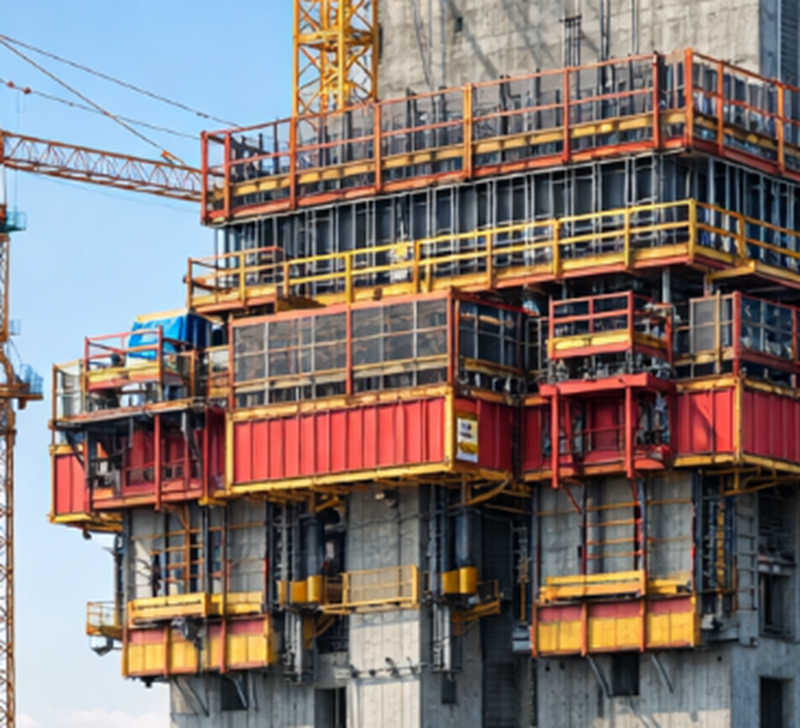
Tower cranes play an essential role in skyscraper construction, but they often become a bottleneck when multiple operations depend on the same lifting equipment. Traditional formwork systems require frequent crane assistance to move heavy panels and support structures from one floor to the next. This dependency can slow down construction progress, particularly when cranes must also handle other tasks such as material lifting and equipment transport.
Self climbing formwork significantly reduces this dependency because the system moves upward using its own hydraulic climbing mechanism. Once installed, the formwork assembly no longer requires crane lifting for each floor transition. Instead, the platform climbs independently along the structure, allowing cranes to focus on other essential construction activities.
This reduction in crane usage improves overall site logistics and reduces scheduling conflicts among different construction operations.
In skyscraper projects, the construction of core walls and shear walls is repeated across dozens of floors. Any delay in one cycle can quickly accumulate and affect the entire project timeline. Self climbing formwork systems help shorten these cycles by eliminating the time required for dismantling, transporting, and reassembling conventional formwork.
Because the system remains attached to the structure, each new construction stage can begin soon after the previous one is completed. This streamlined transition allows teams to maintain a predictable rhythm of construction activities.
The impact of climbing formwork on structural cycle time can be illustrated through the following comparison:
Aspect | Conventional Formwork | Self Climbing Formwork |
Formwork relocation | Requires dismantling and crane lifting | Climbs automatically |
Preparation time | Longer due to assembly | Reduced setup time |
Construction cycle | Less predictable | More consistent |
Another efficiency advantage is the ability to maintain continuous progress along the vertical axis of the building. Traditional formwork systems often require temporary pauses while equipment is moved or repositioned. These interruptions can disrupt workflow and slow down project schedules.
Self climbing formwork avoids these interruptions by remaining attached to the structure throughout the construction process. As soon as one floor is completed and the concrete reaches the required strength, the system climbs to the next level and the following cycle can begin. This continuous progression helps maintain momentum in the construction schedule.
Working at significant heights presents both logistical and safety challenges. Self climbing formwork systems address these challenges by creating a stable and organized working platform for construction teams. Instead of assembling temporary scaffolding or separate work decks at each floor, the integrated platform moves together with the formwork structure.
This centralized workspace improves coordination between teams and reduces unnecessary movement of workers and equipment. As a result, construction activities become more organized and easier to manage, particularly in large skyscraper projects where multiple teams must operate simultaneously.
Self climbing formwork systems are most effective in skyscrapers where reinforced concrete cores serve as the main structural element. These cores often extend continuously through the entire height of the building and include elevator shafts, stairwells, and shear walls. Because these elements require repetitive vertical construction cycles, they are ideal candidates for climbing formwork technology.
Buildings with shear wall structural systems also benefit from this approach, as the system can support large wall surfaces that must be constructed floor by floor with consistent alignment.
Certain construction environments particularly benefit from self climbing formwork systems. For example, projects located in dense urban areas often face space limitations that restrict crane operations and equipment storage. In such situations, reducing reliance on crane lifting can significantly improve site efficiency.
Additionally, construction sites with high demand for lifting equipment can benefit from the system’s ability to move independently along the structure. This allows cranes to focus on transporting materials rather than repositioning formwork.
The advantages of self climbing formwork become more apparent as building height increases. In very tall structures, the construction of the core may extend across dozens of floors and take place over several months. Maintaining a consistent workflow during this extended vertical development is essential for keeping the project on schedule.
Self climbing formwork systems provide a repeatable and stable construction cycle that can be maintained throughout the entire height of the building. This reliability makes them particularly suitable for long-term skyscraper construction projects where efficiency and coordination are critical to project success.
self climbing formwork helps skyscrapers rise faster. It climbs with the structure. Work continues without delay.
Hydraulic systems lift the platform. Teams work on one stable level. Cycles repeat more smoothly.
Tianjin Easy Scaffolding Co., Ltd. provides reliable systems. Its formwork supports safe work. It improves efficiency in tall building construction.
A: Self climbing formwork is a mechanized system that climbs along completed concrete structures to support continuous vertical construction.
A: Self climbing formwork shortens cycle times by eliminating frequent crane lifting and reducing formwork dismantling between floors.
A: Self climbing formwork is commonly used for reinforced concrete cores, shear walls, and elevator shafts in high-rise buildings.
A: Self climbing formwork supports repetitive vertical construction cycles, improving workflow continuity in tall building structures.
A: Self climbing formwork integrates working platforms and lifting systems, allowing coordinated tasks within a stable construction zone.


