
English 
T: +86-13212036031
E: mason@easy--scaffolding.com
E: mason@easy--scaffolding.com
Room No.432, Building No.2, Huijin Plaza, West Fifth Road No.35, Tianjin Airport Economic Zone, Tianjin,China

Views: 0 Author: Site Editor Publish Time: 2026-05-08 Origin: Site


Inaccurate scaffolding material estimation carries massive financial and operational risks. Missing just a few critical components causes expensive labor downtime on site. Worse, structural omissions often trigger emergency freight costs that quickly destroy project margins. Calculating scaffolding goes far beyond merely counting steel pipes. Planners must use a dual approach. You have to verify structural load capacity through rigorous engineering. Concurrently, you must generate an accurate Bill of Materials (BOM) for procurement teams. This guide provides a transparent, engineer-to-engineer framework. We will show you exactly how to estimate a cuplock scaffolding system effectively. You will learn to map out grid variables, apply essential load formulas, and align site realities with strict budget requirements. By the end, you will have a solid structural baseline to keep your next access project safe and compliant.
Accurate calculations must account for both material quantity (BOM) and Safe Working Loads (SWL) based on local compliance (e.g., EN 12811 or OSHA).
Industry-standard safety factors (typically 4:1) must be applied to all vertical and horizontal load estimates.
Generating a precise BOM relies on accurate physical variables: wall dimensions, bay length/width, and the number of active working levels.
Manual calculations carry high scalability risks; engineering sign-off and specialized estimation tools are critical for enterprise-scale deployments.
Manual calculation errors severely impact overall project margins. A simple spreadsheet mistake ripples through the entire construction supply chain. Estimators frequently struggle to balance precise material counts against realistic structural parameters. Let us look at the cascading impacts of getting the numbers wrong.
Under-calculating materials: Shortages lead to immediate site standstills. Crews wait around for missing parts, spiking your hourly labor costs. Procurement teams end up paying expedited shipping premiums. Sometimes, crews improvise. They might use unsafe alternatives to bridge gaps. This directly compromises structural integrity and invites regulatory fines.
Over-calculating materials: Excess materials tie up essential operating capital. You increase transport tonnage unnecessarily. Extra parts waste valuable site storage space. Sorting and returning unused inventory also drains logistical resources.
What makes a calculation framework successful? We define success by three core metrics. First, you need 100% component coverage. This includes all mandatory safety add-ons like guardrails and toe boards. Second, your design must comply strictly with static and dynamic load limits. Finally, you need clear data alignment. Your physical site realities must match the final procurement data perfectly.
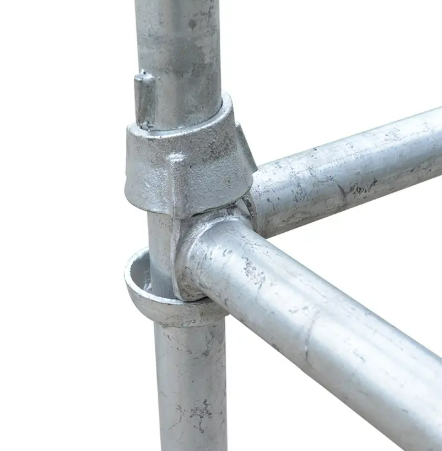
Structural integrity always precedes material counting. You must verify safe working loads (SWL) before calculating any node quantities. Counting parts is useless if the underlying frame collapses under pressure.
Engineers use a rigid baseline rule for structural integrity. The industry relies heavily on a 4:1 safety factor. Suppose a specific vertical standard reaches its structural failure point at 40 tons. We strictly rate its SWL at 10 tons. This substantial buffer protects against unexpected material fatigue. It also absorbs sudden dynamic shocks from dropped equipment.
European standard EN 12811 provides clear load classes. We must design scaffolds based on specific daily applications. Upgrading the load class directly increases the required component density. Here is a breakdown of standard load classes:
Load Class | Design Load (kN/m²) | Typical Application |
|---|---|---|
Class 1 | 0.75 kN/m² | Light inspection, access only |
Class 2 | 1.50 kN/m² | Painting, cleaning, light maintenance |
Class 3 | 2.00 kN/m² | General building work, plastering |
Class 4 | 3.00 kN/m² | Heavy building work, concrete handling |
Class 5 | 4.50 kN/m² | Heavy-duty masonry, industrial storage |
Scaffolding structures endure three distinct load types. You must account for all three in your initial assessment.
Dead Loads: The physical weight of the modular system itself. Steel components carry significant mass.
Live Loads: The variable weight acting on the platforms. This includes active workers, mobile tools, and stacked construction materials like bricks.
Environmental Loads: External forces affecting the structure. Wind shear pushes against the facade. Snow accumulation adds immense top-down pressure.
Disclaimer: All capacity calculations provided here represent structural baseline assumptions. Actual site load limits always require rigorous validation by a certified on-site engineer.
Accurate estimating relies entirely on precise site inputs. You must establish baseline structural dimensions first. Never apply algebraic formulas without securing firm measurements.
Start mapping the target structure. You need the exact total length of the wall face. You also need the maximum required working height. Measure any ground elevation changes too. Sloping ground demands a higher quantity of adjustable base jacks.
Modular systems rely on a rigid internal grid. We call each distinct three-dimensional block a "bay". Let us define the primary variables for this grid.
Bay Length: The distance between vertical standards running parallel to the wall. Common lengths are 1.8m, 2.0m, or 2.5m. Shorter bays increase load capacity.
Bay Width: The distance between vertical standards running perpendicular to the wall. Typical widths range from 0.6m to 1.2m.
Lift Height: The vertical distance between horizontal ledger rows. A standard industry lift is generally 2.0m. This allows workers adequate headroom.
Differentiate your internal platform levels clearly. You must determine the total number of boarded working levels. Contrast these against simple structural tie-levels. Working levels require extra components like toe boards, planks, and double ledgers. Tie-levels only provide frame rigidity and use fewer parts.
We will ground the math using a fixed hypothetical project. This assumption model keeps the algebraic variables clear and easy to follow. You can adapt these steps to any straight facade.
Hypothetical Project Parameters:
Total Length: 12m
Total Height: 6m
Bay Length: 2m
Bay Width: 1.2m
Lift Height: 2m
Standards form the vertical columns of the structure. We must find the total number of node points on the ground plan.
Formula logic: (Total Length / Bay Length + 1) × (Total Width / Bay Width + 1)
Why do we add one? A single bay requires two standards. Two bays require three standards. You always need one extra standard to close the final bay. Let us apply the formula.
Length nodes = (12 / 2) + 1 = 7 nodes.
Width nodes = (1.2 / 1.2) + 1 = 2 nodes.
Total vertical columns = 7 × 2 = 14 columns.
Each column must reach 6m high. We divide this total height by available component lengths. You might use two 3m poles per column. Therefore, total standards = 14 columns × 2 poles = 28 standards.
Ledgers connect the standards horizontally. You calculate them per individual lift.
Formula logic per lift: [ (Length Bays) × (Width Nodes) ] + [ (Width Bays) × (Length Nodes) ]
Length ledgers per lift = 6 bays × 2 nodes = 12.
Width ledgers per lift = 1 bay × 7 nodes = 7.
Total ledgers per lift = 19.
Multiply this by the total number of lifts. Height (6m) / Lift Height (2m) = 3 lifts.
Total ledgers = 19 × 3 = 57 ledgers.
Every vertical column requires a base foundation. This calculation is incredibly simple. Match these components exactly 1:1 with the total vertical columns calculated in the first step.
Total vertical columns = 14.
You need exactly 14 adjustable base jacks. You also need 14 base collars to start the bottom node sequence.
Calculate deck quantities based on specific bay widths. For example, you must fill a 1.2m wide bay. Standard steel planks are often 0.3m wide. You need 4 planks per bay on a working level.
Total length bays = 6. One fully boarded level requires 6 bays × 4 planks = 24 planks.
Next, include diagonal braces. Industry practice places bracing every three to four bays. You also place them at both ends of the structure. Our 6-bay run needs at least two bracing bays per face. Each braced bay takes braces on every lift to prevent swaying.
Manual math often misses the granular realities of a busy job site. Several operational blind spots consistently disrupt construction budgets.
Omission of Safety Components: Estimators frequently forget mandatory safety additions. You must include guardrails, mid-rails, and toe boards. Working heights often require double-ledgers to support heavy board loads. Missing these triggers immediate compliance failures.
Ignoring Topography: Rarely is the ground perfectly flat. Failing to account for uneven ground causes major erection headaches. You must calculate varied lengths of adjustable base jacks. Sometimes, you need staggered starting collars to level the initial lift safely.
Mismatching Component Spans: Assuming all bays are completely uniform is dangerous. Buildings have corners and architectural protrusions. Accommodating curves requires different bay lengths. A rigid spreadsheet often misses these crucial transitional node requirements.
The algebraic formulas above work exceptionally well for simple, straight facades. However, enterprise projects introduce immense geometry complexity.
Manual formulas fail rapidly on complex industrial structures. Adding multi-tiered layouts breaks simple algebraic grids. Human error multiplies exponentially when calculating staggered access levels. Boiler rooms and suspended sections require advanced trigonometric tracking. Spreadsheets simply cannot visualize spatial clashes.
Modern scaffolding design software changes the procurement game entirely. It automates BOM generation accurately. These programs eliminate tedious human counting errors. Furthermore, they provide high-fidelity 3D visualizations. They calculate weight distributions and live SWL parameters automatically as you draw.
Feature | Manual Calculation (Spreadsheets) | Automated Design Software |
|---|---|---|
Speed | Slow, requires formula setup per wall. | Instant BOM generation upon drawing completion. |
Accuracy | Prone to human error and missed components. | 100% node matching; eliminates skipped parts. |
Complex Geometry | Struggles with curves and varying elevations. | Easily adapts to radial and multi-level structures. |
Visual Validation | None; purely abstract data. | Full 3D rendering and clash detection capabilities. |
We strongly advise procurement and site managers to set clear planning boundaries. Use manual calculations strictly for early budgetary estimates. Once you move to execution, submit your CAD drawings or site specs to professional structural partners. They will provide final engineering verification and precise, compliant quoting.
Estimating project materials bridges two distinct construction disciplines. It combines fundamental structural physics with rigorous component counting. You must secure the safe working load parameters first. Only then can you begin tallying up standard nodes and ledgers. Always prioritize overall safety and compliance over mere cost-cutting. Skimping on bracing or guardrails is never worth the regulatory liability.
Manual math gives you a great foundational understanding of your cuplock scaffolding requirements. However, deploying enterprise-grade software guarantees operational perfection. Contact our engineering team today. We provide verified, compliance-checked quotes. You can also access our automated estimation tools to streamline your next major access project.
A: Yes. Cuplock’s modular node design allows for varying angles. Calculation requires adjusting bay lengths and incorporating swivel couplers or variable-length ledgers, usually requiring CAD software for accuracy.
A: The component count may change depending on board width, but the most critical change is the Dead Load. Steel boards significantly increase the self-weight of the structure, altering the SWL calculations.
A: A 4:1 safety factor is the industry standard (e.g., OSHA), meaning the system is engineered to hold four times its maximum intended load. Always design estimates around this threshold.
