
English 
T: +86-13212036031
E: mason@easy--scaffolding.com
E: mason@easy--scaffolding.com
Room No.432, Building No.2, Huijin Plaza, West Fifth Road No.35, Tianjin Airport Economic Zone, Tianjin,China

Views: 0 Author: Site Editor Publish Time: 2026-03-20 Origin: Site


Cities grow taller each year. How do builders pour concrete so high?One answer is self climbing formwork. It moves upward with the structure.In this article, you will learn how self climbing formwork works and why it matters in modern concrete construction.
Self climbing formwork is a specialized formwork system designed to move upward automatically as a concrete structure grows vertically. In conventional construction methods, formwork panels must be dismantled and lifted by cranes after each concrete pour, which requires significant time, labor, and coordination. Self climbing formwork introduces a different approach by integrating a climbing mechanism that allows the formwork to move upward along the structure while remaining attached to it. This mechanism enables the system to progress continuously as each new section of concrete is completed.
The primary purpose of self climbing formwork is to support vertical construction processes in projects such as high-rise buildings, reinforced concrete cores, elevator shafts, and shear wall systems. Because these structures require repeated casting cycles at increasing heights, the ability of the formwork to move with the building significantly improves efficiency and workflow stability. Once installed, the system becomes part of the construction process rather than a temporary component that must be repeatedly dismantled and reassembled.
In practical terms, the system operates through a cycle that begins with reinforcement installation and formwork alignment. Concrete is poured into the mold, and once the material reaches sufficient strength, the formwork assembly climbs to the next level using a hydraulic or mechanical lifting mechanism. Because the system remains connected to previously cast concrete through anchoring devices, it maintains structural stability during the lifting process.
Compared with conventional formwork systems, self climbing formwork offers several structural and operational characteristics that make it particularly suitable for tall concrete structures.
Feature | Description | Construction Impact |
Integrated climbing mechanism | Built-in lifting system moves formwork upward | Reduces need for crane lifting |
Anchored structural support | System attaches to completed concrete sections | Maintains stability during climbing |
Continuous formwork operation | System remains installed throughout project | Improves construction efficiency |
By enabling controlled vertical movement and reducing repetitive installation work, self climbing formwork provides a reliable solution for projects that require precise and efficient vertical construction.
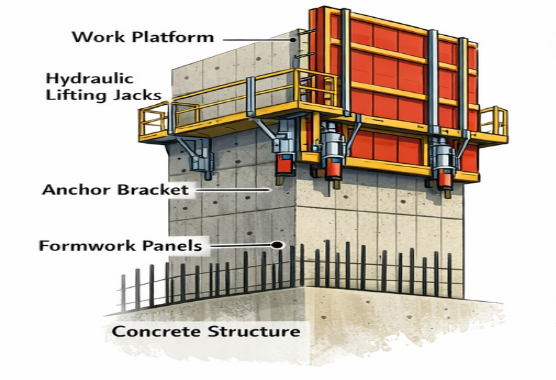
A self climbing formwork system consists of several interconnected structural elements designed to support both the formwork panels and the operational environment required for vertical construction. Each component contributes to the stability, mobility, and safety of the entire system. Understanding these structural elements helps explain how the system functions as an integrated construction platform rather than simply a concrete mold.
At the center of the system are the structural frames and brackets that support the formwork panels. These frames are responsible for carrying the weight of the fresh concrete, the formwork panels themselves, and the workers operating on the platforms. Because fresh concrete exerts significant pressure during pouring, the frames must be designed to maintain rigidity and prevent deformation. The supporting structure also ensures that the formwork remains properly aligned with the building geometry.
Another essential component is the anchoring system. Anchors connect the climbing structure to previously cast concrete sections, transferring loads safely into the structural core of the building. These anchoring points allow the system to remain stable during both concrete casting and climbing operations. Without this secure connection, the formwork assembly could not maintain accurate positioning at increasing heights.
The system also incorporates working platforms that surround the formwork. These platforms allow construction personnel to perform tasks such as reinforcement installation, inspection, and formwork adjustments. In many systems, multiple platform levels are used so that different tasks can occur simultaneously without interfering with each other.
Component | Function | Importance in Construction |
Supporting frames | Carry loads from concrete and formwork panels | Maintain structural stability |
Anchoring devices | Connect system to completed concrete walls | Secure system during climbing |
Work platforms | Provide workspace for construction crews | Improve operational coordination |
Safety barriers | Protect workers operating at height | Enhance construction safety |
Together, these components form a stable and mobile structure capable of supporting both the formwork and the construction teams working around it. The integration of these elements allows the system to function as a complete vertical construction platform.
The operational principle of self climbing formwork is based on a repeated climbing cycle that progresses alongside the construction of the concrete structure. This cycle integrates several stages of construction, including reinforcement installation, formwork alignment, concrete pouring, curing, and system lifting. Each stage must occur in the correct sequence to ensure structural stability and safe operation.
The process begins with the preparation of the formwork and reinforcement. Workers install reinforcing bars inside the formwork panels according to the structural design of the wall or core. Once the reinforcement is in place, the formwork panels are aligned and secured using the supporting frames and anchoring system. Accurate alignment at this stage is essential because it determines the final geometry of the concrete structure.
Concrete is then poured into the formwork molds. During this stage, the structural frames and brackets carry the pressure exerted by the fresh concrete. After pouring, the concrete must cure until it reaches sufficient strength to support the climbing operation. The curing stage ensures that the newly formed section of wall or core can safely support the loads transferred by the anchoring devices.
Once the concrete reaches the required strength, the climbing mechanism begins lifting the formwork assembly. Hydraulic cylinders or mechanical lifting systems raise the entire structure—including the platforms and frames—to the next construction level. After reaching the new position, the system is secured again using new anchor points embedded in the concrete.
The climbing cycle can be summarized as follows:
Stage | Activity | Purpose |
Reinforcement preparation | Install steel reinforcement | Prepare structural core |
Concrete casting | Pour concrete into formwork | Create new wall section |
Concrete curing | Allow material to gain strength | Support next stage |
Climbing operation | Lift formwork to next level | Continue vertical construction |
By repeating this cycle, the formwork system moves upward with the building. This process allows construction teams to maintain a steady rhythm of work, which is particularly important in tall buildings where vertical progress determines the overall construction schedule.
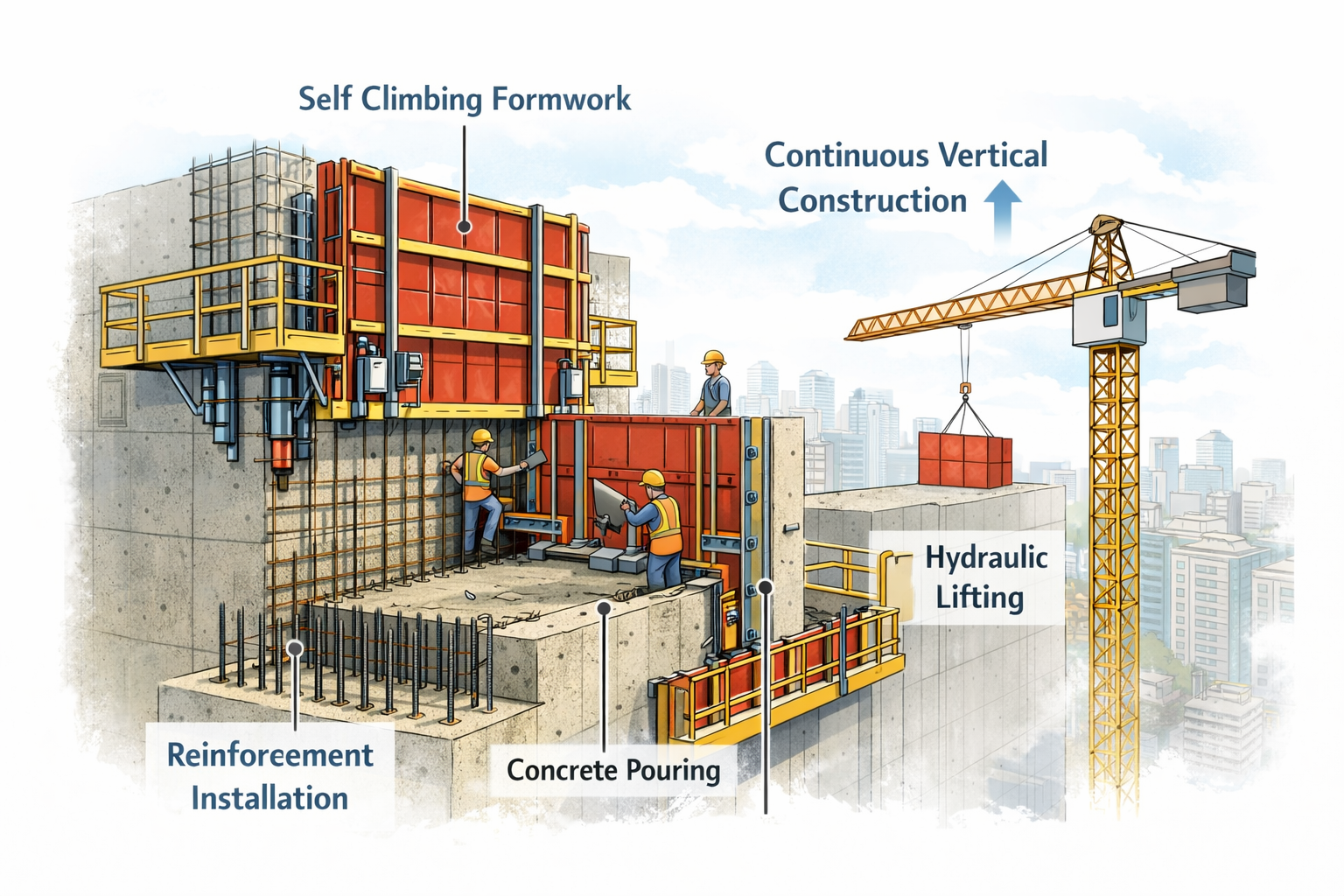
High-rise construction requires the creation of tall structural elements that extend through many floors of a building. These elements often include reinforced concrete cores, shear walls, and elevator shafts. Because these structures must be constructed continuously from the base to the upper levels of the building, formwork systems that support repeated vertical construction cycles become essential. Self climbing formwork fulfills this role by enabling the formwork to move upward as the structure grows.
In a high-rise building project, the central concrete core often acts as the primary structural element that stabilizes the entire building. The construction of this core typically begins early in the project and continues throughout the vertical development of the building. Because the geometry of the core remains largely consistent from floor to floor, self climbing formwork can be used repeatedly without significant modification. This ability to reuse the same system across multiple levels helps maintain efficiency and consistency throughout the project.
Another important role of the system is maintaining a continuous workflow for vertical construction. Once the system is installed, construction teams can follow a regular cycle of reinforcement installation, concrete pouring, curing, and climbing operations. This consistent rhythm allows project managers to plan labor allocation and equipment scheduling more effectively.
Continuous construction also reduces interruptions in the building process. Traditional formwork methods require dismantling and relocating equipment after each stage, which can create delays and logistical complications. In contrast, self climbing formwork remains attached to the structure, allowing it to move upward without interrupting the construction sequence.
By enabling uninterrupted vertical construction, the system helps maintain progress in projects where height is a defining characteristic of the structure.
In tall buildings, structural accuracy is critical because small deviations can accumulate as the structure rises. If formwork panels are not aligned correctly during each stage of construction, the resulting errors could affect wall thickness, structural stability, or the placement of building components. Self climbing formwork contributes to maintaining alignment by providing a stable and anchored platform for the formwork panels.
The anchoring system plays a key role in maintaining precision during vertical construction. Anchors embedded in previously cast concrete sections hold the formwork assembly securely in place. Because the system is attached to the structure itself, it can maintain consistent positioning relative to the building geometry. This stability helps ensure that each new section of wall aligns with the previous one.
Another factor that contributes to construction precision is the controlled movement of the climbing mechanism. Hydraulic lifting systems allow the formwork to move upward gradually and evenly. This controlled motion reduces the risk of misalignment during the climbing process and ensures that the system remains balanced as it reaches higher levels.
Maintaining structural precision also improves the quality of the finished concrete surfaces. Stable formwork panels reduce movement during concrete pouring, which helps produce uniform wall surfaces and consistent dimensions. In high-rise buildings where structural elements must meet strict engineering requirements, this consistency becomes particularly important.
Through its anchored support system and controlled climbing operations, self climbing formwork plays an important role in maintaining structural accuracy throughout the vertical construction process.
One of the primary advantages of self climbing formwork is the efficiency it introduces into vertical construction projects. Traditional formwork systems require workers to dismantle and reassemble panels after each concrete pour, often relying on cranes to lift heavy components to higher levels. This process can slow down construction and create logistical challenges on busy construction sites. Self climbing formwork addresses these challenges by allowing the entire formwork assembly to move upward as a single unit.
Once installed, the system can remain in operation for the entire construction of a vertical structure. Each cycle follows the same sequence of reinforcement installation, formwork alignment, concrete pouring, curing, and climbing. Because the system does not need to be dismantled between stages, the time required to prepare for the next construction cycle is significantly reduced. This efficiency allows construction teams to maintain a predictable workflow throughout the project.
Another advantage of the system is its contribution to improved scheduling. In high-rise construction, project timelines often depend on the speed at which the building core can be constructed. By enabling regular and consistent construction cycles, self climbing formwork helps project managers estimate completion times more accurately.
The improvement in workflow stability also benefits coordination among construction teams. When the construction cycle follows a consistent pattern, different teams responsible for reinforcement, inspection, and concrete pouring can plan their tasks around the same schedule.
Safety is a major consideration in vertical construction environments where workers operate at significant heights above ground level. Self climbing formwork systems incorporate integrated safety features that create a controlled working environment for construction personnel. These features include work platforms, guardrails, and protective barriers that surround the formwork system.
The platforms built into the system provide stable surfaces where workers can install reinforcement, inspect formwork alignment, and manage concrete pouring operations. Because these platforms remain attached to the system as it climbs upward, workers do not need to relocate their workspaces repeatedly. This stability reduces the risk associated with working at height.
Another important advantage is the reduced dependence on cranes for formwork repositioning. In many construction projects, cranes are already responsible for lifting heavy materials such as steel reinforcement, structural components, and equipment. If formwork panels also require crane lifting after each stage, it can create scheduling conflicts and increase the complexity of site logistics.
Self climbing formwork reduces this dependence because the system moves upward using its own lifting mechanism. As a result, cranes can be reserved for transporting materials rather than relocating formwork. This improved equipment allocation can simplify construction planning and reduce congestion on busy construction sites.
The combination of improved safety conditions and reduced reliance on lifting equipment makes self climbing formwork an effective solution for projects that involve tall concrete structures.
The installation of self climbing formwork begins after the initial section of the concrete structure has been completed. At this stage, engineers install the base formwork assembly around the structural element being constructed, typically a reinforced concrete core or shear wall. Anchoring points embedded in the concrete provide the structural support needed to attach the climbing system.
During the setup stage, the supporting frames, work platforms, and climbing equipment are assembled into a single structure. Engineers carefully align the formwork panels to ensure that the geometry of the wall or core matches the design specifications. Because the system will move upward using the same structural framework, accurate alignment at this stage is essential.
After installation, the system operates through a repeated climbing cycle that continues as the building rises. Workers first install reinforcement bars and adjust the formwork panels for the next section of the structure. Concrete is then poured into the formwork molds. Once the concrete has cured and gained sufficient strength, the climbing mechanism raises the formwork assembly to the next level.
The operational sequence generally follows a predictable workflow:
Construction Stage | Activity | Purpose |
Formwork alignment | Prepare panels and reinforcement | Ensure structural accuracy |
Concrete pouring | Cast new wall section | Extend structure upward |
Concrete curing | Allow strength development | Support climbing operation |
Formwork climbing | Lift system to next level | Continue vertical construction |
Throughout this process, coordination between construction teams is essential. Engineers monitor the stability of the anchors and the alignment of the formwork system during each climbing stage. Supervisors ensure that climbing operations begin only after the concrete reaches the required strength.
Because the system operates at increasing heights as construction progresses, careful monitoring and communication between teams remain critical throughout the project. When properly coordinated, the climbing system allows construction teams to build tall concrete structures in a controlled, efficient, and stable manner.
Self climbing formwork supports tall concrete construction. It allows steady vertical building progress.The system improves efficiency and work safety.
It keeps construction cycles organized.Tianjin Easy Scaffolding Co., Ltd. provides reliable systems. Their solutions support stable and efficient projects.
A: Self climbing formwork is a system that moves upward with a concrete structure, enabling continuous vertical construction without frequent crane repositioning.
A: Self climbing formwork is commonly used in high-rise cores, shear walls, bridge pylons, and other tall concrete structures requiring repeated vertical casting.
A: Self climbing formwork reduces dismantling and crane lifting, allowing faster construction cycles and more predictable project scheduling.
A: A self climbing formwork system typically includes climbing brackets, hydraulic lifting units, anchors, structural frames, and integrated working platforms.
A: Engineers consider self climbing formwork for projects with tall vertical elements where repetitive wall construction and stable climbing cycles improve productivity.


