
English 
T: +86-13212036031
E: mason@easy--scaffolding.com
E: mason@easy--scaffolding.com
Room No.203, Building No.5, Huijin Plaza, West Fifth Road No.35, Tianjin Airport Economic Zone, Tianjin, China

Views: 0 Author: Site Editor Publish Time: 2026-04-30 Origin: Site


Selecting the wrong temporary access structure often leads to cascading project delays. It also causes blown labor budgets and critical OSHA compliance violations. Site managers understand these stakes intimately. Buyers must navigate a maze of highly localized safety standards. They face strict load-bearing requirements daily. You also face a fundamental trade-off between initial material cost and daily assembly speed. A heavy industrial project requires entirely different equipment than a simple residential exterior paint job.
This article provides an evidence-based framework for evaluating core temporary structures. We will explore foundational structural categories and modern proprietary variations. We aim to enable confident decision-making for contractors, estimators, and site managers. You will learn how terrain, load classes, and architectural shapes dictate your equipment selection. We also clarify common industry misconceptions so you allocate equipment safely. By standardizing your procurement approach, you protect your workers and safeguard your project timeline. A well-chosen scaffolding system significantly improves job site efficiency while mitigating inherent safety risks.
Scaffold selection strictly follows a MECE (Mutually Exclusive, Collectively Exhaustive) baseline: structures are either supported from the ground up or suspended from above.
The transition from traditional tube and clamp setups to modular scaffolding systems (like Ringlock and Cuplock) significantly reduces labor hours but requires higher upfront capital.
Equipment compliance relies on strict parameters: standard 48.3mm tube diameters, specific surface treatments (e.g., hot-dip galvanization), and adherence to the OSHA 3:1 height-to-base ratio to prevent tipping.
Project managers must evaluate site terrain, maximum load capacity (Load Class), and structure shape before issuing procurement or rental POs.
Engineers categorize temporary access platforms using a mutually exclusive approach. Structures either build upward from the ground or hang downward from a host structure. Understanding this primary engineering split helps project managers immediately narrow their procurement options.
Supported setups rely entirely on foundation stability. They transmit all structural weight and live loads directly into the ground.
Frame and Brace (Fabricated Frame): This remains the most common choice in North America for residential and light commercial work. Crews deploy it very quickly. However, it requires a completely level foundation. It also struggles heavily under industrial point loads.
Mobile Scaffolds: These are independent towers resting on casters. A critical evaluation point is wheel safety. Every unit must feature locking wheel brakes. Mobile units work best for transient, low-height tasks like painting or localized MEP (mechanical, electrical, plumbing) installations.
Mast Climbing Scaffolds: These feature motorized drive units attached to a fixed vertical mast. They are ideal for heavy masonry and extensive facade work. They offer massive lifting capacity while maintaining a surprisingly small ground footprint.
Common Mistakes with Supported Structures
Many contractors fail to assess ground compaction before erection. Placing base plates on loose soil inevitably causes differential settlement. This shifting compromises the entire tower. Always use heavy timber sole boards under base plates on unpaved ground.
Suspended platforms utilize wire ropes and overhead rigging. They bypass ground-level obstacles entirely.
Two-Point (Swing Stage): This serves as the industry standard for skyscraper maintenance. Window washing crews and high-rise glazing contractors rely heavily on swing stages.
Multi-Point Adjustable: Complex industrial structures require these platforms. You will see them inside silos, large storage tanks, and tall industrial chimneys.
Implementation Risk: Suspended structures offer a zero ground footprint. However, they carry strict weight limitations. They also exhibit high vulnerability to wind conditions. Project managers must mandate daily weather checks. High winds can easily turn a suspended platform into a dangerous pendulum.
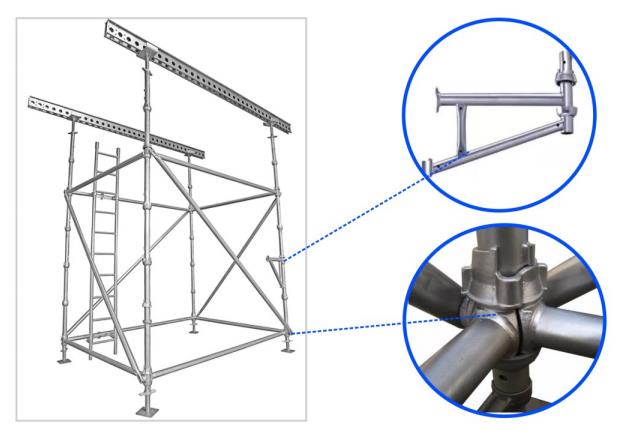
Procurement teams constantly debate between legacy methods and modern proprietary systems. This B2B decision impacts labor scheduling and capital expenditure simultaneously.
This legacy method utilizes standard outer diameter (O.D.) 48.3mm steel or aluminum tubes. Workers connect these tubes using specialized right-angle and swivel couplers.
Pros: This method provides ultimate flexibility. Crews can navigate highly irregular architectures easily. It also boasts a much lower initial material cost compared to proprietary systems.
Cons: It remains extremely labor-intensive. You need highly skilled, certified scaffolders to assemble it safely. These experts must calculate load distribution manually and verify joint integrity at every connection point.
Modern options utilize pre-engineered components featuring standardized, fixed connection points. They remove guesswork from the assembly equation.
Ringlock Scaffolding: Engineers in Germany developed this robust system. It features a unique rosette node allowing up to eight connection directions. Ringlock serves as the global standard for heavy infrastructure, load-bearing shoring, and complex industrial access.
Cuplock Scaffolding: This system originated in the United Kingdom. It uses a top-and-bottom cup mechanism locking up to four horizontal ledgers simultaneously. It proves exceptional for curved structures. Cuplock remains highly popular in the Middle East (especially the UAE) and European markets.
Kwikstage Scaffolding: This variant uses a V-press connection and a captive wedge fixing. It dominates construction sites in Australia and the UK. Kwikstage proves highly efficient for straight structural facades and large residential housing tracts.
Comparison Table: Tube & Clamp vs. Modern Systems
Feature | Tube & Clamp | Modern System (e.g., Ringlock) |
|---|---|---|
Connection Method | Manual right-angle & swivel couplers | Fixed rosettes or locking cups |
Assembly Speed | Slow; requires constant measuring | Fast; pre-measured node spacing |
Labor Skill Level | High; requires advanced training | Moderate; intuitive locking mechanisms |
Architectural Flexibility | Maximum; adapts to any geometry | High; but constrained by fixed component lengths |
Standard frames cannot solve every operational hurdle. Certain niche tasks require highly specialized equipment to ensure safe access.
Bricklayers face unique access challenges. They typically choose between two specific setups.
Single (Putlog): This setup relies directly on the building wall for support. Workers insert putlog tubes into holes left within the brickwork. It works perfectly for standard, lower-level bricklaying tasks.
Double (Independent): Stonemasons utilize this completely free-standing structure. They choose independent platforms when drilling into a finished facade is structurally or aesthetically prohibited. It requires an inner and outer row of vertical standards to support the load independently.
A cantilever structure projects outward from the building framing using angled steel needles. It is mandatory when ground access remains impossible. You will use this above active roadways, steep sloped roofs, or extremely weak soil zones.
This system operates on a vertical pole mechanism similar to an automobile jack. Workers pump a foot pedal to raise the platform. It provides a cost-effective solution for residential siding installations. However, OSHA guidelines strictly restrict its height, typically capping it at 48 feet.
Contractors often blur the lines between access platforms and structural supports. This misconception leads to dangerous misallocations of site equipment. We must draw a firm line between the two.
Engineers design a scaffold primarily to support personnel, their hand tools, and immediate working materials. Evaluators test these structures under standard access load classes (e.g., Light Duty at 25 psf, Medium Duty at 50 psf). They provide a safe working deck, not a structural foundation.
Engineers design shoring strictly to support massive structural weight. You use shoring to hold up wet concrete formwork slabs. You also use it for underpinning unsafe foundations during historical renovations. Shoring systems handle tremendous vertical loads.
While some robust proprietary systems (like O.D. 60mm Ringlock) easily adapt for heavy shoring duties, basic frames cannot. Traditional access frames should never substitute for structural shoring without a dedicated engineering stamp. Misusing light-duty access frames for concrete falsework is a leading cause of catastrophic site collapses.
Procuring the correct temporary structure requires a logical evaluation model. Estimators and project managers should follow this practical, feature-to-outcome framework.
First, evaluate the ground conditions. Does the soil support heavy point loads? If not, you must use heavy-duty base plates and widespread sole boards to distribute the weight. Uneven or sloping terrain heavily favors adjustable modular systems over basic fabricated frames. Modular systems feature screw jacks that accommodate drastic elevation changes effortlessly.
Next, analyze your project timeline against local labor rates. For short-term projects featuring highly complex architectural shapes, Tube & Clamp often wins. However, for long-term, heavy industrial projects, a Ringlock system proves superior. The higher initial material cost is quickly offset by rapid, repeatable labor assembly cycles.
You must verify adherence to regional standards before finalizing any rental or purchase. In the US, consult OSHA Subpart L. In Europe, follow BS EN 12811-1. You must also factor in the crucial "3-to-1 Rule" (some local codes mandate 4:1). Structures exceeding three times their minimum base dimension must tie securely into the host building to prevent catastrophic tipping.
Finally, ask if fixed structures are even necessary. Evaluate if Aerial Lifts, Boom Lifts, or Scissor Lifts provide a better return on investment. For short-duration tasks requiring minimal personnel, mobile mechanical lifts often negate the need for fixed framing entirely.
Decision Matrix Chart
Project Scenario | Recommended Structure Type | Key Rationale |
|---|---|---|
High-rise glass replacement | Two-Point Suspended (Swing Stage) | Bypasses height limits; zero ground footprint. |
Heavy industrial tank construction | Ringlock System | Handles immense point loads; wraps around curved edges. |
Residential brickwork (low height) | Frame and Brace | Inexpensive; rapid deployment on level soil. |
Complex heritage building restoration | Tube & Clamp | Navigates intricate stonework without fixed node limits. |
Selecting the best temporary access platform requires calculating several variables. You must map site terrain, assess required load classes, review local labor rates, and confirm project duration. No single product solves every construction access problem perfectly.
However, standardizing your inventory on a single, versatile scaffolding system scales operations efficiently. Systems like Ringlock or Cuplock reduce component fragmentation across multiple job sites. This standardization also dramatically simplifies workforce training. Crews assemble familiar components faster and safer.
Take proactive steps before issuing your next procurement order. Consult closely with licensed structural engineers or reputable equipment manufacturers. Map your precise load requirements against specific component capabilities to guarantee structural integrity.
A: The globally recognized standard outer diameter (O.D.) is 48.3mm. Manufacturers maintain this specific measurement to ensure strict interoperability between various fittings, couplers, and proprietary modular components across international markets.
A: OSHA formally identifies the "big four" fatal hazards. These include falling from unsecured elevations, being struck by falling objects or tools, accidental electrocution from nearby power lines, and catastrophic structural collapse due to overloading or poor foundation support.
A: Mixing proprietary brands introduces severe engineering risks. Even within the same system type (like Cuplock), different manufacturers use varying steel grades and precise tolerances. Mixing parts voids manufacturer warranties and creates unpredictable load distributions, significantly increasing the risk of joint failure.


