
English 
T: +86-13212036031
E: mason@easy--scaffolding.com
E: mason@easy--scaffolding.com
Room No.203, Building No.5, Huijin Plaza, West Fifth Road No.35, Tianjin Airport Economic Zone, Tianjin, China

Views: 0 Author: Site Editor Publish Time: 2026-03-06 Origin: Site


How do tall buildings rise so quickly today? Modern projects need efficient construction systems. One important solution is self climbing formwork, a system that allows formwork platforms to move upward with the structure during construction.
In the construction equipment industry, companies such as Tianjin Easy Scaffolding Co., Ltd. develop scaffolding and formwork systems used in high-rise building projects. In this article, you will learn what self climbing formwork is, how it works, its main components, and where it is commonly used in vertical concrete construction.
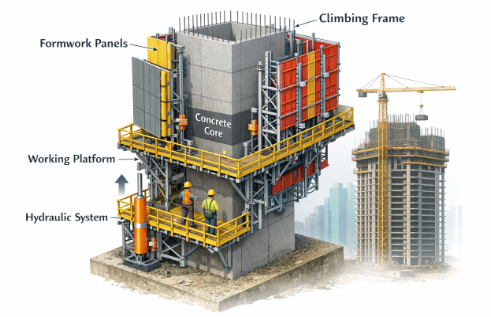
Self climbing formwork is a specialized construction system used to build reinforced concrete structures that rise vertically, such as high-rise building cores, shear walls, and elevator shafts. Unlike traditional formwork systems that must be lifted and repositioned by tower cranes after each concrete pour, self climbing formwork is designed to move upward along the structure as construction progresses. This ability allows the formwork assembly, working platforms, and support systems to remain connected to the building while advancing from one level to the next.
Self climbing formwork is a construction system used in high-rise concrete structures where the formwork platform climbs upward along the building as construction progresses. Unlike conventional formwork that must be lifted by cranes, the system uses integrated climbing mechanisms—often hydraulic—to move vertically while remaining anchored to the structure.
In modern construction projects, this system supports continuous vertical building processes. Workers can perform reinforcement installation, concrete pouring, and inspection activities directly from the integrated platforms attached to the formwork structure. Once a section of concrete has cured to the required strength, the system climbs to the next level, allowing the construction cycle to continue with minimal interruption.
A self climbing formwork system combines several structural elements that operate together to support vertical construction. Rather than functioning as independent pieces of equipment, these components form an integrated platform that moves upward along the building as the structure grows.
At its core, the system consists of formwork panels, support frames, climbing mechanisms, and working platforms. The formwork panels shape the reinforced concrete walls, while the structural frame supports the loads generated during concrete pouring and construction activities. The climbing mechanism enables the entire assembly to move upward, and the working platforms provide safe areas for construction crews to perform their tasks.
One key feature of this system is its connection to the partially completed concrete structure. Anchoring points embedded in previously poured concrete provide attachment locations for the climbing system. These anchors allow the formwork assembly to remain securely connected to the building while it moves vertically.
Because the system remains attached to the structure throughout construction, alignment can be maintained more easily than with conventional crane-lifted formwork. This structural concept allows construction teams to build tall reinforced concrete structures efficiently while maintaining consistent wall geometry across many levels.
In high-rise building projects, vertical concrete structures are typically constructed through a sequence of repeated casting cycles. Self climbing formwork supports this process by allowing the formwork system to move upward after each level of concrete is completed. Instead of dismantling and relocating formwork panels at every stage, the climbing system advances along the building in a controlled and continuous process.
During construction, the formwork assembly remains attached to the structure through anchoring brackets and guide systems. Once a section of concrete reaches the required strength, the climbing mechanism lifts the entire platform—including formwork panels, support frames, and working decks—to the next construction level.
This approach allows construction teams to maintain a stable workflow, which is especially important in tall buildings where dozens of vertical casting cycles may be required.
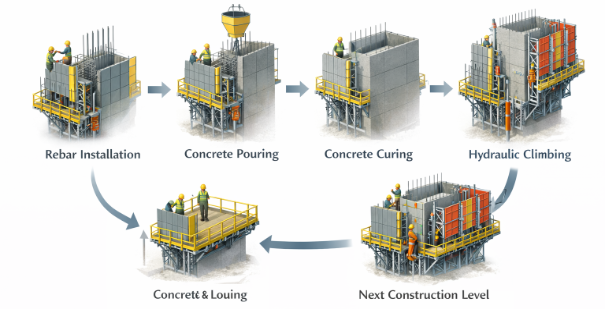
The operation of a climbing formwork system follows a repeated sequence of construction stages. Each stage prepares the structure for the next vertical section of concrete.
Typical construction cycle:
1. Reinforcement installation and formwork positioning Before concrete is poured, reinforcement bars are installed according to the structural design. Formwork panels are positioned around the reinforcement cage, creating the mold that defines the shape of the concrete wall or core.
2. Concrete pouring and curing Concrete is poured into the formwork panels and allowed to cure. During this stage, the formwork assembly remains firmly attached to the structure through anchoring systems that stabilize the platform.
3. Climbing operation Once the concrete reaches the required strength, the climbing mechanism activates and lifts the entire formwork structure to the next construction level.
4. Preparation for the next cycle After the system reaches its new position, it is secured to new anchor points and the next construction cycle begins.
This process continues repeatedly until the vertical structure reaches its final height.
Most modern self climbing formwork systems rely on hydraulic mechanisms to perform the climbing movement. Hydraulic cylinders generate the force required to lift the entire formwork assembly, including panels, working platforms, and construction equipment.
Guide rails are installed alongside the structure to ensure that the system moves upward in a controlled path. These rails prevent lateral movement and help maintain the correct vertical alignment of the formwork.
The interaction between hydraulic devices and guide systems is essential for safe and stable climbing operations.
Component | Function |
Hydraulic cylinders | Provide lifting force to move the formwork upward |
Climbing brackets | Connect the lifting system to the structural frame |
Guide rails | Maintain vertical alignment during climbing |
Structural anchors | Transfer loads to the concrete structure |
Together, these elements allow the formwork assembly to climb smoothly along the building without requiring crane lifting.
Maintaining stability during climbing operations is critical, particularly in tall structures where construction occurs at significant heights. To ensure safe operation, self climbing formwork systems rely on embedded anchoring points within the previously cast concrete structure.
These anchors support the weight of the formwork system and transfer loads safely to the building. During climbing, the anchors also guide the movement of the system, ensuring that lifting occurs in a controlled and balanced manner.
In addition to structural stability, worker safety is supported through integrated platform systems. Construction crews operate from multi-level working decks that include guardrails, safety barriers, and designated access routes.
Common safety features include:
● Guardrail systems that help prevent falls from elevated platforms
● Enclosed working areas that protect workers during reinforcement installation and concrete pouring
● Controlled lifting mechanisms that ensure smooth vertical movement of the formwork assembly
By combining structural anchoring, hydraulic lifting systems, and integrated safety platforms, self climbing formwork allows construction teams to perform vertical building operations safely and efficiently.
A self climbing formwork system consists of several structural and mechanical components that operate together during vertical construction. These components allow the system to maintain stability, support construction activities, and move upward along the structure as each concrete section is completed.
Because the system must withstand heavy loads from fresh concrete, workers, and equipment, every component plays a specific role in maintaining structural integrity during the construction cycle.
Formwork panels are the surfaces used to mold reinforced concrete walls, cores, and other vertical elements. These panels determine the shape and finish of the concrete structure and must remain precisely aligned throughout the construction process.
Supporting these panels are structural frames and brackets that distribute loads across the formwork assembly. These frames stabilize the panels during concrete pouring and maintain rigidity during climbing operations.
Key functions of formwork panels and support structures include:
● Shaping reinforced concrete walls and vertical cores
● Maintaining accurate dimensions and alignment across multiple construction levels
● Transferring loads from fresh concrete and construction equipment to the climbing structure
Together, these elements form the primary structural framework of the climbing formwork system.
Hydraulic climbing devices provide the mechanical force required to lift the formwork system between construction levels. Hydraulic cylinders extend upward along climbing rails or brackets attached to the structure, gradually raising the entire assembly.
Because hydraulic systems allow controlled lifting, they are widely used in climbing formwork technology. The lifting process occurs in a series of coordinated steps that keep the platform balanced while moving vertically.
Some building-focused systems incorporate specialized hydraulic climbing configurations, including solutions such as the Safety Hydraulic Self-Climbing System (SCP) designed for vertical construction environments.
Anchoring systems connect the climbing formwork assembly to the concrete structure. Anchors are typically embedded in the concrete during earlier construction stages and later serve as attachment points for the climbing system.
These anchoring components perform several important roles:
● Supporting the weight of the formwork structure
● Transferring loads to the building structure
● Guiding the system during vertical movement
Guide rails are installed along the structure to control the climbing path. They ensure that the formwork assembly moves vertically without unwanted horizontal displacement.
Structural Element | Role in the System |
Embedded anchors | Support and secure the climbing structure |
Climbing brackets | Connect anchors to the formwork frame |
Guide rails | Maintain vertical alignment |
Working platforms are integrated into the formwork structure to provide safe and organized areas for construction activities. These platforms are usually arranged at multiple levels around the formwork assembly.
Each level is designed for specific tasks. Upper platforms may be used for reinforcement installation, while lower platforms support formwork adjustments and concrete finishing operations.
Important features of these platforms include:
● Multi-level working decks that allow different construction activities to occur simultaneously
● Guardrail systems that protect workers from falls during high-elevation operations
● Access routes and ladders that allow safe movement between platform levels
By integrating working platforms into the climbing structure, the system provides a stable environment where crews can carry out construction tasks safely while the building continues to rise.
Self climbing formwork systems are widely used in projects that involve tall reinforced concrete structures. These systems are particularly effective in environments where vertical construction must be repeated over many levels while maintaining consistent alignment.
In modern high-rise construction, self climbing formwork supports continuous building processes by allowing the formwork platform to climb along the structure as each level is completed.
One of the most common uses of self climbing formwork is in the construction of structural cores. Core walls are central elements of high-rise buildings and typically contain elevator shafts, stairwells, and service ducts.
Because these structures extend vertically through the entire height of the building, climbing formwork allows construction teams to maintain alignment while repeating the same construction cycle across many floors.
Typical applications include:
● Elevator shafts that require smooth and accurately aligned concrete walls
● Stair cores that form part of the building’s structural stability system
● Service cores containing mechanical and electrical systems
Self climbing formwork is also widely used in the construction of tall reinforced concrete towers. In these projects, shear walls and structural cores are built continuously from the foundation upward.
Because the formwork system climbs along the structure, construction teams can maintain a steady workflow without repeatedly dismantling and relocating formwork panels.
Common structural elements built with climbing formwork include:
Structural Element | Purpose in High-Rise Buildings |
Shear walls | Provide lateral resistance against wind or seismic loads |
Reinforced concrete cores | Support elevators and service systems |
Vertical structural walls | Transfer loads from upper floors to the foundation |
By supporting continuous vertical construction, self climbing formwork has become an important technology in modern reinforced concrete high-rise projects.
Self climbing formwork plays an important role in modern reinforced concrete construction, allowing formwork platforms to move upward with the structure during each building stage. Through coordinated climbing mechanisms, structural components, and repeated construction cycles, the system supports efficient and controlled vertical construction in high-rise projects. Solutions developed by Tianjin Easy Scaffolding Co., Ltd. provide reliable formwork systems that help improve construction efficiency, structural accuracy, and on-site safety.
A: Self climbing formwork is used to construct vertical reinforced concrete structures such as core walls, elevator shafts, and shear walls in high-rise buildings.
A: Self climbing formwork moves upward using hydraulic or mechanical climbing systems after each concrete pour reaches the required strength.
A: A self climbing formwork system typically includes formwork panels, support frames, hydraulic climbing devices, guide rails, and working platforms.
A: Self climbing formwork is most suitable for tall concrete structures where repeated vertical construction cycles are required.


