
English 
T: +86-18842539857
E: anniescaffolding@163.com
E: anniescaffolding@163.com
Room No.203, Building No.5, Huijin Plaza, West Fifth Road No.35, Tianjin Airport Economic Zone, Tianjin, China

Views: 0 Author: Site Editor Publish Time: 2026-03-09 Origin: Site


The 3 to 1 rule is a simple stability guideline used on many construction sites.
It means that a free-standing scaffold structure should not be higher than three times its minimum base width, unless additional stabilization measures such as ties, anchors or structural bracing are provided.
In practical terms, if the smallest base dimension of a scaffold is 1 meter, the free-standing height should not exceed 3 meters.
The purpose of this rule is not to replace engineering design, but to provide a quick and practical reference for site safety control.
Scaffold structures are vulnerable to overturning when they become tall and slender.
Horizontal forces such as wind, worker movement and material handling generate overturning moments at the base.
The 3 to 1 rule limits the slenderness of a scaffold and helps reduce the risk of:
excessive sway,
loss of base contact,
sudden global instability.
It is therefore mainly a stability-control concept rather than a strength-based design rule.
The rule is most often used for small and light-duty access structures that are erected independently without ties to permanent buildings.
Typical examples include small access towers and temporary working platforms used for short-term operations.
For large structural scaffolds and shoring systems, the rule is usually only used as an initial reference.
The height-to-base ratio refers to the total vertical height of the scaffold divided by the smallest effective base width.
The smaller the base width and the higher the structure, the greater the overturning tendency becomes.
This simple ratio is used to describe how slender a scaffold is.
A wider base increases resistance against overturning, while a taller structure increases the overturning effect caused by horizontal forces.
The 3 to 1 rule limits this relationship and helps ensure that the stabilizing effect of the base is not exceeded by the destabilizing effect of height.
It is therefore mainly a geometric control method.
On many sites, the rule is applied to small mobile or static access towers.
When the working height needs to be increased beyond the 3 to 1 limit, ties, outriggers or anchoring systems are normally added to maintain stability.
For basic frame scaffolding that is used as a light access structure and erected as a free-standing unit, the 3 to 1 rule is still widely referenced.
It provides a simple way for supervisors and installers to judge whether additional stabilization is required.
For tube and coupler scaffolding, the 3 to 1 rule is much less reliable as a safety indicator.
The actual stability of a tube scaffold depends heavily on bracing arrangement, connection quality and overall geometry, which cannot be reflected by a single height-to-base ratio.
In practice, tube and coupler scaffolding usually requires engineering judgement and project-specific design.
In modern modular scaffolding systems, stability is normally controlled by predefined system layouts, bracing rules and anchoring methods.
The 3 to 1 rule may still be used as a quick site reference, but it is not the primary design principle.
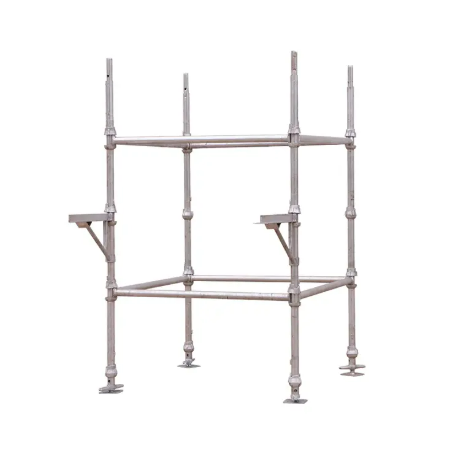
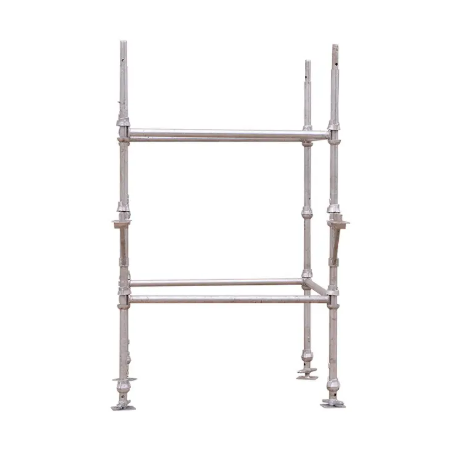
For small and temporary free-standing structures, the 3 to 1 rule can still be used as a very basic stability reference for cuplock scaffolding.
However, in most real construction projects, cuplock scaffolding is rarely designed only according to this simple rule.
It is normally part of a larger engineered layout, connected to permanent structures or stabilized through systematic bracing.
Cuplock scaffolding uses rigid cup-and-blade node connections and standardized bay geometry.
The vertical standards form continuous load-carrying columns, while ledgers and diagonal braces create a regular and stiff structural grid.
These characteristics allow stability to be controlled more effectively through system design rather than through a simple geometric ratio.
A complete cuplock scaffolding system is normally designed based on:
planned structural layout,
bracing and tie-in positions,
working and construction loads,
project height and environmental conditions.
As a result, stability is managed through engineering configuration instead of relying only on the 3 to 1 rule.
Diagonal bracing is one of the main elements controlling lateral stability in cuplock scaffolding.
It limits horizontal deformation and distributes lateral forces across multiple bays, which significantly increases resistance to overturning and sway.
In most medium and high structures, cuplock scaffolding is tied to permanent structures.
These ties transfer horizontal loads directly into the building or structural frame and greatly reduce the reliance on base width for stability.
This approach is fundamentally different from the 3 to 1 rule, which only controls geometry.
The spacing between standards and the arrangement of ledgers determine the stiffness of the scaffold grid.
Smaller bays and symmetrical layouts improve global stability and allow higher structures to be built safely even when the height-to-base ratio exceeds 3 to 1.
For tall cuplock shoring towers and high access scaffolds, stability is governed by structural height, load magnitude and lateral restraint conditions.
In such cases, the 3 to 1 rule alone is clearly insufficient and must be replaced by proper structural layout design.
When cuplock scaffolding is used to support slabs, beams and formwork systems, the dominant risk is not only overturning but also global structural behavior under heavy loads.
Engineering design becomes essential.
In industrial plants, bridges and infrastructure projects, working environments are complex and exposed to wind and dynamic loads.
These conditions require a systematic stability design approach rather than a simple geometric rule.
For most cuplock projects, layout design is based on engineering calculation, taking into account load combinations, bracing layout and tie-in spacing.
Systematic diagonal bracing and regular tie-in positions are the primary methods used to control lateral stability in a cuplock scaffolding system.
Even with good bracing and anchoring, proper base preparation and uniform bearing capacity are still fundamental to maintaining stability.
The total scaffold height should be measured from the base support to the highest working level, while the smallest effective base width should be considered for the ratio.
This check can be used as an initial on-site stability screening.
When the planned height exceeds the simple 3 to 1 limit, or when loads and environmental conditions are significant, tie-ins and anchoring must be introduced according to the project layout design.
The 3 to 1 rule can be treated as a basic awareness tool, while the real safety control should come from the cuplock scaffolding system layout, bracing pattern and tie-in design.
The 3 to 1 rule is a simple and useful guideline for identifying potential stability risks in small, free-standing scaffold structures.
However, when applied to professional cuplock scaffolding, it should only be treated as a basic reference rather than a design principle.
In modern construction, a properly configured cuplock scaffolding system relies on systematic bracing, tie-ins, controlled geometry and engineering layout to achieve real structural stability and safety.
As a professional cuplock scaffolding manufacturer, Tianjin Easy Scaffolding Co., Ltd provides a complete cuplock scaffolding system with consistent component accuracy and stable joint performance, supporting contractors with reliable products for engineered layouts, high shoring structures and complex site conditions.
By combining quality manufacturing with system-level configuration support, Tianjin EASY helps customers move beyond simple rules such as the 3 to 1 ratio and build safer, more efficient scaffolding solutions for real construction projects.

