
English 
T: +86-13212036031
E: mason@easy--scaffolding.com
E: mason@easy--scaffolding.com
Room No.432, Building No.2, Huijin Plaza, West Fifth Road No.35, Tianjin Airport Economic Zone, Tianjin,China

Views: 0 Author: Site Editor Publish Time: 2026-04-28 Origin: Site


Look at any major commercial skyline today. You will quickly notice temporary metal frameworks hugging the buildings. While historical systems like bamboo or wood still exist in certain regions, modern commercial construction demands better solutions. Contractors rely heavily on highly engineered metal temporary structures.
Selecting a scaffold involves much more than simply reaching a high elevation. Project managers must balance expensive labor costs and complex structural geometry. They must also meet heavy payload requirements and adhere to stringent safety compliance rules. Making the wrong choice often leads to project delays and severe safety hazards.
This guide bypasses basic top-of-funnel definitions completely. We provide project managers and procurement teams with a practical, evidence-based framework. You will learn how to evaluate the most prevalent scaffolding system designs on the market. We aim to help you make smarter, safer, and more efficient site equipment decisions.
The Global Standard: Steel ground-supported scaffolds dominate the industry, but the specific type varies heavily by project scale and region.
For Speed and Simplicity: Welded Frame scaffolding is the most commonly used system in North America for residential and light commercial projects due to its fast assembly.
For Complex Commercial: System scaffolding (Modular types like Ringlock and Cuplock) is the most utilized globally for heavy industry and irregular building facades.
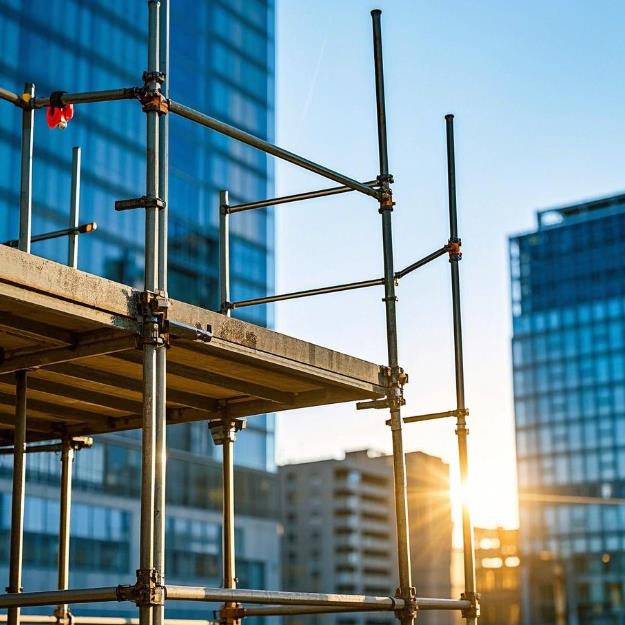
Ground-supported, galvanized steel equipment serves as the undisputed baseline across the globe. It offers immense durability and handles intense weather conditions perfectly. Steel structures dominate the commercial landscape, but regional realities dictate actual market adoption.
Frame setups dominate residential and light commercial markets in the United States. Traditional tube and clamp setups remain a historical staple in the United Kingdom. Meanwhile, contractors in Australia and Scotland heavily prefer Kwikstage designs for their specific projects.
You should note the massive industry-wide shift toward modularization. Companies are aggressively moving away from highly labor-intensive traditional methods. They now favor pre-engineered solutions. Modern modular designs minimize loose fittings. They dramatically reduce human error during installation. This shift improves overall site safety and accelerates project timelines considerably.
We can outline a primary decision matrix for 80% of standard construction projects. Most site managers choose between basic frame designs and advanced modular setups.
Design Mechanism: This design relies on pre-welded vertical steel frames. Workers connect these frames using simple steel cross braces. They stack the frames vertically using basic coupling pins.
Business Use Case: This equipment is ideal for straight, flat building facades. You will see it constantly on residential builds. It also serves perfectly for basic painting, masonry, and stucco applications.
Pros & Cons: Frame equipment features an extremely low learning curve. Crews can erect it very fast. However, it completely lacks structural flexibility. You cannot easily navigate complex architectural curves. It struggles around dense industrial piping. It also fails to meet heavy-duty load-bearing requirements on massive commercial sites.
Design Mechanism: Modular structures utilize standardized vertical posts called standards. Horizontal ledgers connect to these posts. They lock together at fixed node points. Ringlock uses round rosettes for its connections. Cuplock uses distinct forged cup nodes.
Business Use Case: Contractors use modular setups for large-scale commercial construction. They are essential for chemical plants, oil refineries, and offshore rigs. Bridge construction also relies heavily on these modular frameworks.
Pros & Cons: Modular equipment offers a superior balance of high load capacity and geometric adaptability. It carries a higher upfront capital cost than basic frames. However, it drastically reduces labor hours on complex structural designs. Workers spend less time measuring and adjusting connections.
Frame vs. System Comparison Chart
Feature | Frame and Brace | System (Modular) |
|---|---|---|
Primary Application | Residential, flat facades, light commercial | Heavy industrial, complex curves, bridges |
Assembly Speed | Very fast for basic straight walls | Fast, especially around irregular obstacles |
Load Capacity | Light to medium duty | Heavy duty |
Flexibility | Low (fixed dimensions) | Extremely high (multi-directional nodes) |
Design Mechanism: This remains the oldest steel assembly method in the industry. It connects standard unthreaded steel tubes. These tubes typically feature a strict 48.3mm outer diameter. Workers use specialized right-angle and swivel couplers to join the tubes securely.
Evaluation Criteria: This method provides unmatched versatility. You can build it to accommodate literally any obstacle. It fits irregular shapes and navigates tight, confined spaces perfectly. You are never restricted by fixed ledger lengths or pre-welded nodes.
Implementation Risk: Building this setup is highly labor-intensive. You must hire highly skilled and certified personnel. They must ensure absolute structural integrity. They alone manage correct load distribution across the tubes. It is rarely the most economical choice for straightforward vertical builds due to immense labor hours.
Your chosen material heavily impacts deployment speed, site safety, and overall project budget. We must assess these material constraints closely.
Galvanized Steel (Q235/Q355): This acts as the heavy-duty standard globally. It offers supreme load-bearing capacity. It guarantees extreme stability and excellent fire resistance. It remains the primary choice for high-rises and heavy masonry work. The major trade-off involves its high shipping weight. This weight causes significant labor strain during manual assembly.
Aluminum (6061-T6): Aluminum weighs up to 75% less than steel. It reduces transportation costs remarkably. It also lowers human fatigue for your crew. You should use it for mobile rolling tower scaffolds. It proves ideal for indoor maintenance tasks where facility floor load limits matter. The trade-off involves a much higher procurement cost. It also carries significantly lower maximum load thresholds.
Fiberglass (FRP): This represents a niche but critical material. It is entirely non-conductive and highly chemical-resistant. It serves as the strictly mandated choice for electrical substations. You must use it in specific hazardous industrial environments to prevent fatal electrocution.
Material Assessment Table
Material | Core Benefit | Ideal Environment | Major Drawback |
|---|---|---|---|
Galvanized Steel | Maximum strength and durability | Outdoor heavy construction, masonry | Extremely heavy, labor-intensive |
Aluminum | Lightweight and rust-proof | Indoor maintenance, rolling towers | Lower weight capacities, expensive |
Fiberglass | Non-conductive, chemical resistant | Electrical grids, chemical plants | High cost, niche application only |
Every job site presents physical limitations. Project managers must address these limitations by choosing between ground-supported frameworks and suspended aerial solutions.
Supported Scaffolding: Crews build this equipment from the ground up. It is reliable and easily scalable. You can add levels as the building rises. However, it absolutely requires stable, level ground foundations. You also need ample physical space around the building footprint to erect the wide base.
Suspended Scaffolding (Two-Point / Swing Stage): Crews hang this platform from the roof. They use heavy wire ropes and motorized hoists. It represents the mandatory standard for skyscraper window washing. It is also vital for high-rise facade repairs. You must use suspended equipment when ground support is impossible or economically prohibitive.
Alternative Access (Cantilever & Mast Climbers): Sometimes you just need brief access over an obstacle. You can briefly position needle-beam or cantilever setups for bridging obstacles. Mast climbers offer another powerful alternative. They handle heavy-payload vertical movement efficiently. You utilize mast climbers to avoid erecting full temporary structures.
Regulatory Baselines: Any system you choose must conform strictly to rigorous regional standards. You must follow OSHA 29 CFR Part 1926 Subpart L in the United States. If you operate in Europe, you must comply fully with the BS EN 12811-1 performance requirements. Ignoring these regulations leads to severe fines and site shutdowns.
Safety Risk Mitigation: OSHA data clearly indicates a grim reality. Falls related to temporary structures are a leading cause of workplace fatalities annually. You must prioritize equipment featuring built-in safety mechanisms. Always demand integrated guardrails. Install premium non-slip walkboards. Secure your toe-boards to prevent tools from falling onto workers below. Proper safety training remains non-negotiable for every single crew member.
Selecting the correct structural equipment requires a systematic approach. You can finalize your procurement decision by following a straightforward framework.
Assess the payload: Determine whether your crews will handle light-duty painting or heavy-duty masonry and steelwork.
Map the geometry: Review the building architecture. Choose frame setups for basic straight walls. Select modular systems like Ringlock for complex, curved facades.
Determine the environment: Analyze site hazards carefully. Mandate fiberglass for electrical hazards. Deploy mobile aluminum towers for tasks requiring constant relocation.
Your next step should involve expert validation. We highly recommend consulting a licensed structural engineer or a specialized equipment provider. Have them audit your site-specific load requirements thoroughly before you issue any purchase orders.
A: Modular systems like Ringlock generally offer the highest safety levels. They feature fixed connection points and pre-engineered load limits. This specific design minimizes human error during manual assembly. It ensures reliable stability for heavy-duty commercial construction and provides secure attachment points for advanced guardrails.
A: These two systems serve entirely different functions. A scaffold primarily supports human workers and light hand materials during construction. Shoring is specifically engineered to support the immense dead weight of building structures. You use shoring to hold up curing concrete slabs or compromised structural walls.
A: OSHA strictly regulates structure heights based on base dimensions and tie-in rules. However, any temporary structure exceeding 125 feet in total height legally requires a custom design. A licensed professional engineer must approve this design to guarantee structural integrity against wind and load forces.
A: Renting makes logical sense for short-term projects or specialized, infrequent tasks. Buying equipment is much more economical if you perform continuous, long-term construction work. You should purchase your gear if your crews utilize the exact same structural components across multiple jobs year-round.


