
English 
T: +86-18842539857
E: anniescaffolding@163.com
E: anniescaffolding@163.com
Room No.203, Building No.5, Huijin Plaza, West Fifth Road No.35, Tianjin Airport Economic Zone, Tianjin, China

Views: 0 Author: Site Editor Publish Time: 2026-03-09 Origin: Site


Ringlock scaffolding is a modular scaffolding system that uses a rosette (ring disc) welded on the vertical standard.
Horizontal ledgers and diagonal braces are connected to the rosette by wedge heads and fixed with hammer locking.
This system is well known for its:
multi-directional connection capability
flexible angle adjustment
strong adaptability to irregular building shapes
It is often selected for complex façades, industrial structures and projects with non-standard layouts.
Cuplock scaffolding is a modular access and support system based on a cup-and-blade node connection.
Ledgers and braces are fixed at the standard by a lower cup and locked by a rotating upper cup.
Compared with many other modular systems, cuplock scaffolding focuses on:
simple and fast connection
highly repetitive and regular layouts
strong load-carrying performance
It is widely used for access platforms as well as heavy-duty shoring structures.
A cuplock scaffolding system refers to a complete and compatible set of components designed around the same cup joint principle, including:
cuplock standards
cuplock ledgers
diagonal braces
base jacks and U head jacks
platforms and safety accessories
The system concept ensures consistent performance, predictable load capacity and fast site installation.
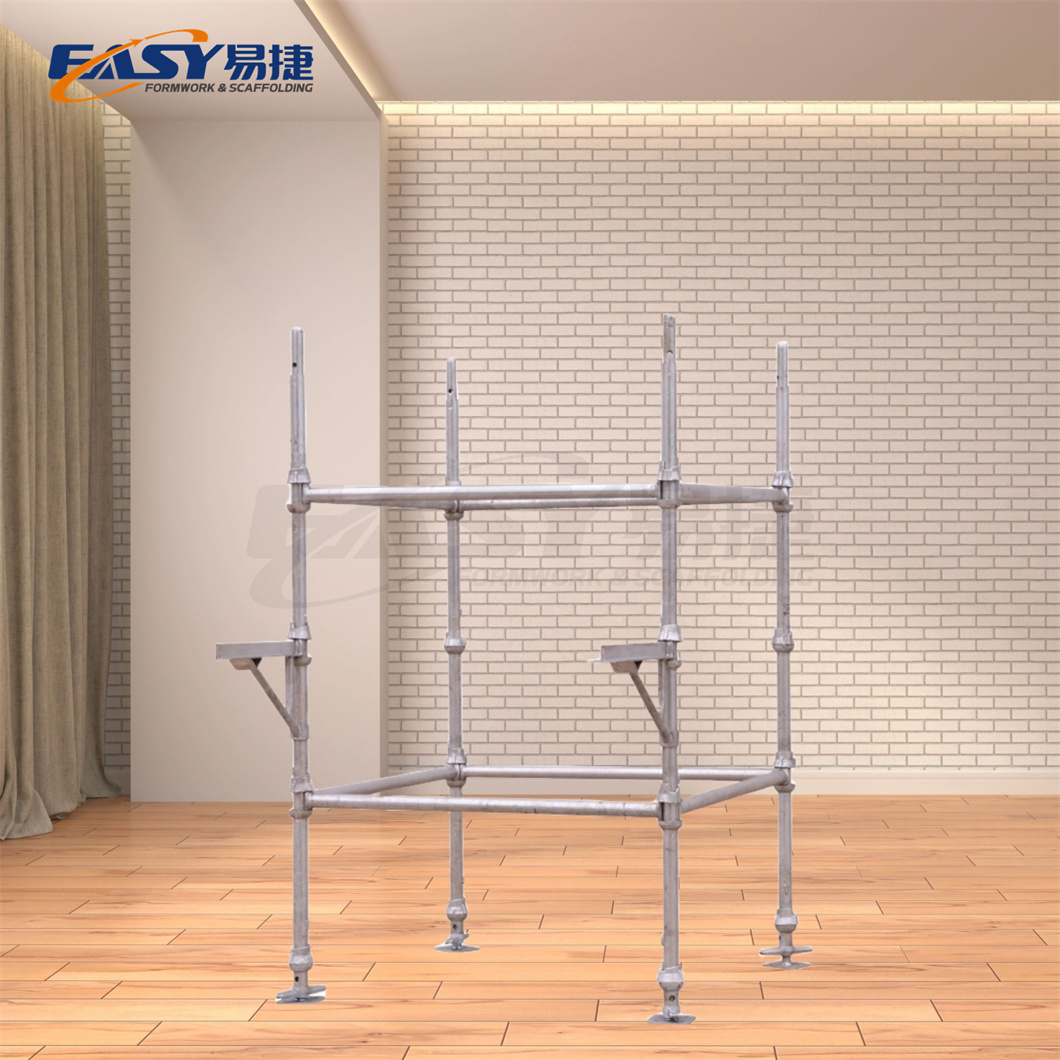
Ringlock standards are welded with a rosette disc.
Ledgers and braces are connected by inserting wedge heads into the disc slots and then hammered into position.
This design allows:
multiple connection angles
fast locking and unlocking
flexible orientation for irregular geometry
In cuplock scaffolding, blade ends of ledgers and braces sit on a fixed lower cup and are locked by a rotating upper cup.
This mechanism provides:
one-action locking of several members
consistent joint geometry
reliable load transfer at each node
It is especially suitable for repetitive structural grids.
Both systems use the same basic elements:
vertical standards
horizontal ledgers
diagonal braces
However, the connection interface and spacing rules differ, which directly affects layout flexibility and installation efficiency.
A cuplock scaffolding system is designed around fixed cup spacing and standardized blade geometry.
This ensures that:
components are highly interchangeable
layouts remain consistent across large projects
engineering calculation becomes easier and more reliable
Ringlock scaffolding generally provides more freedom for:
angled connections
irregular bay arrangements
complex three-dimensional structures
Cuplock scaffolding, on the other hand, performs best in:
regular grids
repetitive floor layouts
standard shoring and access configurations
Ringlock scaffolding allows fast connection by hammering wedge heads into the rosette disc.
It performs well when:
multiple angles are required
layouts change frequently
complex structures must be assembled on site
However, the higher number of connection directions may increase layout complexity for large repetitive projects.
Cuplock scaffolding is particularly efficient for large-scale and repetitive layouts.
Several ledgers and braces can be locked at one node by simply rotating the upper cup.
This results in:
fewer installation steps
reduced handling of fittings
faster erection and dismantling cycles
For repetitive structures, the cuplock scaffolding system often delivers higher productivity.
The ringlock wedge connection is very flexible, but requires correct orientation and hammering at every node.
The cuplock joint allows multiple components to be secured in one action, which significantly reduces time per node when large quantities of scaffolding are installed.
Both ringlock and cuplock scaffolding are engineered systems capable of carrying significant vertical loads.
In practice, cuplock scaffolding is more commonly selected for projects where:
vertical load demand is high
load paths must be simple and direct
shoring towers and formwork support are required
The vertical load is transferred mainly through the standards and cup joints directly to the base.
Ringlock scaffolding offers good horizontal stability and performs well in structures with complex shapes, provided sufficient diagonal bracing is installed.
Cuplock scaffolding achieves lateral stability mainly through:
regular grid layouts
systematic bracing arrangements
rigid and repeatable node geometry
This helps maintain consistent stiffness across large working areas.
Cuplock scaffolding is frequently used as a shoring system because:
the joint design allows efficient load transfer
the vertical standards form a continuous and regular load path
spacing and layout are easy to control on site
These characteristics make cuplock scaffolding highly suitable for:
slab formwork support
beam and girder support
high shoring towers
A properly designed cuplock scaffolding system can support large concrete formwork areas with:
predictable load distribution
simple layout control
efficient installation sequences
For projects with repetitive floor structures and tight schedules, cuplock scaffolding is often considered a more practical and economical solution.
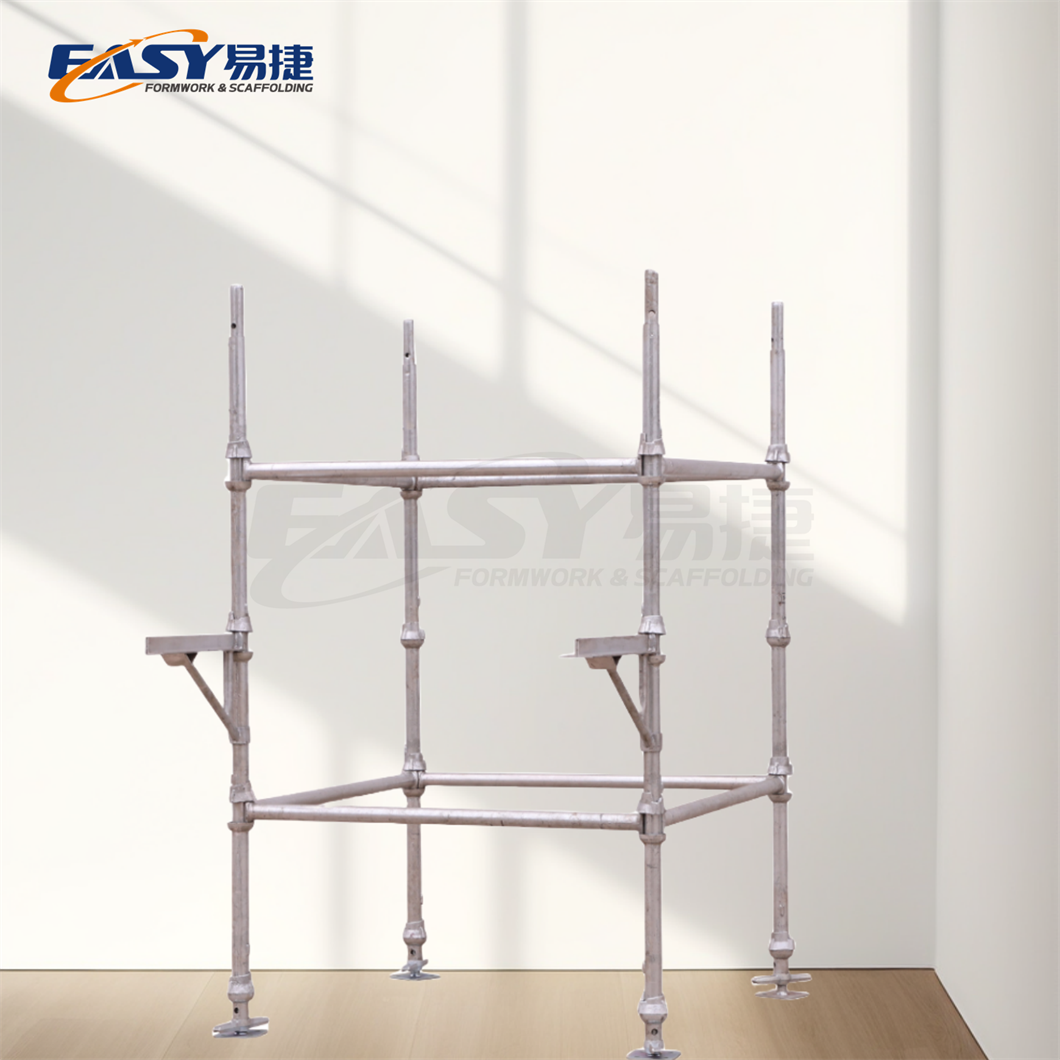
Ringlock scaffolding is often chosen for projects with complex geometry, curved façades and irregular structural layouts.
Because the rosette node allows multi-directional connections, it is easier to create angled bays, cantilevered areas and non-standard access routes.
This makes ringlock scaffolding suitable for:
irregular façades
industrial structures with many obstructions
projects requiring frequent layout changes on site
Cuplock scaffolding performs best in projects with repetitive grids and standardized layouts.
Typical applications include:
multi-storey buildings with identical floor plans
large flat slab structures
repetitive access platforms
The regular spacing and consistent node positions make layout control and installation much easier.
Cuplock scaffolding is widely used as a shoring structure for:
slab formwork
beam and girder formwork
transfer structures
Its vertical load path is clear and direct, which makes it especially suitable for heavy concrete structures.
Besides shoring, cuplock scaffolding is also commonly used for:
façade access platforms
interior maintenance platforms
industrial plant access structures
A single cuplock scaffolding system can be configured for both access and support tasks by adjusting the layout and spacing.
Ringlock scaffolding offers excellent flexibility in connection angles.
Ledgers and braces can be connected in multiple directions from one rosette, which helps when building irregular frames and complex 3D structures.
This flexibility is an important advantage for projects with non-standard geometry.
Cuplock scaffolding focuses on modular and repetitive layouts.
Its connection design is optimized for:
regular bay sizes
uniform vertical spacing
fast grid-based installation
This modular characteristic improves productivity on large-scale projects.
Although cuplock scaffolding is based on regular grids, a well-planned cuplock scaffolding system can still adapt to different site requirements through:
variable bay sizes
different bracing arrangements
customized access and platform configurations
This makes it suitable for both building construction and industrial projects.
Both systems use positive mechanical locking methods.
Ringlock scaffolding relies on wedge locking into the rosette disc, while cuplock scaffolding uses the rotating cup to secure blade ends.
In repetitive layouts, cuplock joints provide highly consistent connection quality from node to node.
In ringlock scaffolding, incorrect orientation of wedge heads or missing components can affect performance if not carefully controlled.
Cuplock scaffolding reduces this risk because:
several members are locked together in one operation
joint geometry is fixed and standardized
This helps reduce assembly mistakes, especially on large projects.
For high shoring towers and heavy support frames, cuplock scaffolding is widely recognized for its stable geometry and predictable structural behavior.
With proper bracing and spacing control, the system provides excellent stability for vertical load-dominated structures.
The initial material cost of ringlock and cuplock systems varies by market and specification.
In many regions, cuplock scaffolding is competitively priced for large quantities used in repetitive projects.
Installation efficiency plays a major role in total project cost.
Because several members can be locked in one action, cuplock scaffolding usually requires:
fewer installation steps
less handling time per node
This can significantly reduce labor costs on large projects.
Both systems are reusable and designed for long-term service.
However, the simpler joint structure of cuplock components often results in:
easier inspection
lower repair complexity
For contractors who frequently carry out slab, beam and shoring projects, a standardized cuplock scaffolding system can offer better long-term economic performance due to:
high reuse rate
efficient storage and logistics
stable component compatibility over time
For high-rise buildings with repetitive floor structures, cuplock scaffolding is often the more efficient solution for shoring and internal access.
Cuplock scaffolding is particularly suitable for:
residential towers
commercial buildings
large flat slab projects
where standardized layouts bring major productivity advantages.
Ringlock scaffolding is often preferred for industrial maintenance where access geometry is complex and constantly changing.
Both systems are used in infrastructure projects.
Cuplock scaffolding is commonly selected for repetitive support frames, while ringlock scaffolding is often used for complex access structures.
If the project involves many irregular shapes and non-standard connections, ringlock scaffolding may be more suitable.
For repetitive layouts, cuplock scaffolding is usually more efficient.
If the main function is heavy-duty support and formwork shoring, cuplock scaffolding is often the preferred option.
Both systems can be used at height, but layout control, foundation conditions and bracing requirements should be carefully evaluated.
The availability of a complete system, technical support and reliable delivery capability should always be part of the decision.
Ringlock is more flexible in angle connections, but this does not mean cuplock scaffolding cannot be adapted to different layouts.
Cuplock systems simply focus on efficiency and regularity.
No.
Cuplock scaffolding is widely used for both access platforms and heavy-duty support structures.
Yes.
By changing configuration and spacing, one cuplock scaffolding system can be used for multiple applications.
Both systems are safe when properly designed and installed.
For repetitive structures, cuplock scaffolding often offers more consistent joint performance.
Cuplock scaffolding is more widely used for heavy concrete slabs, beams and transfer structures.
For large-scale projects with repetitive layouts, cuplock scaffolding is usually easier to manage and control.
There is no single answer to whether ringlock or cuplock is universally better.
The right choice depends on project geometry, structural function and construction workflow.
For projects that focus on heavy-duty support, repetitive layouts and high installation efficiency, cuplock scaffolding clearly shows strong advantages.
A well-planned cuplock scaffolding system offers predictable structural performance, fast erection and excellent long-term economic value.
As a professional cuplock scaffolding manufacturer, Tianjin Easy Scaffolding Co., Ltd supplies a complete range of cuplock standards, ledgers, braces, jacks and accessories under a fully integrated manufacturing and export system.

