
English 
T: +86-13212036031
E: mason@easy--scaffolding.com
E: mason@easy--scaffolding.com
Room No.432, Building No.2, Huijin Plaza, West Fifth Road No.35, Tianjin Airport Economic Zone, Tianjin,China

Views: 0 Author: Site Editor Publish Time: 2026-05-11 Origin: Site


Modern contractors face a heavy burden today. You constantly battle shrinking project timelines and severe skilled labor shortages. Increasingly strict safety regulations add to this daily pressure. Sticking to outdated methods often delays progress and eats into profit margins. This reality drives a massive transition across the industry. Construction teams are rapidly moving away from traditional pipe-and-fitting setups. They now favor advanced, modular structural solutions to stay competitive. At the forefront of this shift, the cuplock scaffolding system has emerged as a dominant industry standard. It fundamentally changes how crews build temporary structures on active sites.
Cuplock scaffolding effectively balances incredible structural integrity with lightning-fast assembly speed. It provides a reliable, high-ROI solution for challenging environments. These include large-scale, heavy-duty, and functionally complex construction zones. By understanding its underlying mechanics and ideal applications, you can make smarter equipment choices. You will learn how this system streamlines workflows, improves site safety, and handles immense physical loads without slowing down your crew.
Speed & Simplicity: The interlocking node design eliminates loose fittings, drastically reducing erection and dismantling time.
Labor Efficiency: Lowers the technical skill threshold required for safe assembly compared to traditional pipe setups.
High Load Capacity: Safely supports heavy loads (up to 74 kN in optimal setups), making it ideal for infrastructure and high-rise projects.
Objective Trade-offs: While requiring a higher initial investment and offering slightly less micro-flexibility than pipe systems, the long-term operational savings justify the cost for continuous project pipelines.
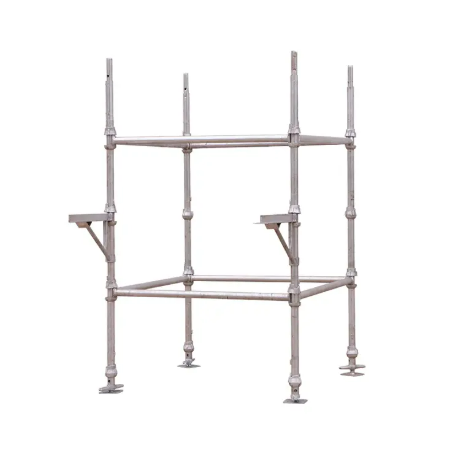
The engineering genius of this modular structure lies in its central connection points. We refer to this as the node mechanism. The design relies on a fixed bottom cup welded directly to the vertical standard. A sliding top cup sits just above it on the same pole. Workers insert the forged blade ends of up to four horizontal ledgers into the fixed bottom cup. They then drop the sliding top cup over the blades. A simple hammer strike securely locks the entire node into place. This intuitive action instantly creates a rigid, perfectly squared grid.
One primary advantage is the total elimination of loose parts. Traditional systems require hundreds of loose nuts, bolts, and wedges to secure connections. These small pieces easily fall into mud, drop from heights, or go missing during transport. Removing these loose elements eliminates a major source of material loss on site. It also removes a common point of human error during assembly. Workers no longer waste time searching for dropped bolts or over-tightening faulty clamps.
Baseline performance data proves the reliability of this design. Structural stability benchmarks show excellent resistance to bending, shearing, and torsion. The rigid node connections distribute weight evenly across the entire framework. When crews pair the system with appropriate universal base jacks, optimal setups can safely support load capacities up to 74 kN. This immense strength gives engineers deep confidence when planning heavy material storage or massive concrete pours.
Instant rigidity: A single hammer strike secures four components simultaneously.
Loss prevention: Captive top cups prevent the misplacement of locking mechanisms.
Shear resistance: Forged ledger blades resist extreme torsional forces during high winds.
You cannot use a lightweight solution for a heavyweight problem. Matching your equipment to specific project demands ensures both safety and efficiency. This system excels in several demanding environments.
Heavy Infrastructure Projects: You will frequently see this equipment used in bridge building, massive viaducts, and highway overpasses. These massive projects require high load-bearing support templates. The formwork must withstand the immense weight of wet concrete and heavy machinery vibrations. The robust nodes provide non-negotiable stability for these critical infrastructure pours.
Curved and Non-Standard Facades: Modern architecture rarely relies on perfectly straight lines. Buildings often feature sweeping curves or irregular exterior profiles. Crews can easily adjust the arrangement of ledgers and transoms to hug these curved facades. This adaptable grid system effectively follows complex interior and exterior building shapes without compromising structural integrity.
Functional Site Structures: Utility goes far beyond standard wall access for painters. Contractors utilize the framework to erect high-capacity loading bays. These bays safely support heavy pallets of bricks, steel framing, and equipment right at the working level. Additionally, crews build multi-level staircase towers. These sturdy towers improve overall site logistics. They allow large numbers of workers to safely and rapidly transit between multiple floors.
Smart contractors evaluate temporary structures beyond their initial purchase price. The true business case relies on labor savings, safety compliance, and material longevity. Upgrading to a modern cuplock scaffolding system significantly alters your operational budget.
Bridging the skill gap presents a massive labor cost advantage. Traditional pipe scaffolding requires a steep learning curve. Highly skilled scaffolders demand premium wages to build complex, micro-adjusted pipe frameworks. In contrast, modular node systems offer an intuitive, highly repeatable setup process. This drastically lowers the technical skill threshold required for safe assembly. General laborers can rapidly assist in the erection process under basic supervision. This efficiency dramatically reduces overall labor hours on your site.
Compliance and safety assurance protect your workforce and your business from liabilities. You should frame the locking mechanism as an active safety feature. The interlocking cups actively prevent accidental ledger dislodgment. Even if a worker kicks a horizontal bar, the locked cup holds it firmly in place. This inherent structural safety aligns perfectly with stringent EN (12810/12811) guidelines and OSHA safety standards. Site inspectors heavily favor systems featuring built-in, tamper-resistant locking mechanisms.
Finally, consider the lifespan value of the materials. Hot-dip galvanized components effectively resist harsh environmental corrosion, rust, and physical impact. High-quality galvanized steel yields a reliable 10+ year operational lifespan. This exceptional durability dramatically lowers your ongoing maintenance costs. It effectively eliminates the need for constant equipment replacements, ensuring long-term value across a decade of project pipelines.
Choosing the right framework requires an objective look at competing alternatives. Let us break down how this method compares to other popular options available to contractors.
When comparing against traditional pipe and fitting systems, the verdict is clear. The modular cup approach wins decisively on assembly speed and lower labor costs. Pipe frameworks take significantly longer to measure, level, and clamp together. However, pipe retains a specific edge for hyper-irregular, micro-adjusted structures in extremely tight industrial spaces.
Comparing against standard frame scaffolding reveals different project intents. Frame systems feature pre-welded H-frames. The verdict here favors frames only for lightweight, low-rise tasks like residential painting or exterior cleaning. They lack sheer physical strength. Conversely, the cup-based modular grid provides the heavy-duty load capacity and vertical adaptability strictly required for high-rise structural concrete work.
Finally, we look at ringlock scaffolding. The verdict positions the cup system as the robust, cost-effective workhorse handling 90% of standard commercial projects. Ringlock serves as a premium, slightly more expensive upgrade. It specifically targets highly complex geometries requiring multi-angle rosette connections. If your project features extreme circular structures or offshore oil rig dimensions, ringlock might be necessary. Otherwise, the cup system remains the superior financial choice.
System Type | Primary Strength | Assembly Speed | Labor Skill Required | Best Application |
|---|---|---|---|---|
Cuplock | High load capacity & rigidity | Very Fast | Low to Medium | Heavy infrastructure, commercial high-rises |
Traditional Pipe | Extreme micro-flexibility | Slow | Very High | Irregular industrial spaces, tight repairs |
Frame | Lightweight simplicity | Fast | Low | Low-rise painting, simple masonry |
Ringlock | Multi-angle connections | Very Fast | Medium | Complex geometries, offshore platforms |
No engineering solution is perfectly flawless. Understanding practical site limitations helps you prepare effective mitigation strategies before construction begins. Being transparent about these realities ensures smoother operations.
Size flexibility constraints remain a known hurdle. Vertical standards feature fixed cup intervals. Manufacturers typically weld these nodes exactly 0.5m or 0.6m apart. You cannot easily slide a connection up or down by a few inches. Mitigation: This rigidity requires more precise upfront project planning. Engineering teams must utilize 3D modeling software during the planning phase. Proper modeling helps accommodate non-standard building elevations by selecting the exact combination of base jacks and varying vertical pole lengths.
Component vulnerabilities also cause occasional site headaches. While major parts remain secure, workers occasionally lose the small U-shaped connecting pins used on certain intermediate transoms. Rapid teardowns and messy transport processes often swallow these small parts. Mitigation: Site managers must implement strict inventory binning protocols. You should mandate daily hardware counts. Always procure an extra supply of standardized backup pins before the project begins to prevent unexpected delays.
Upfront capital expenditure presents a financial reality. Validating this higher initial manufacturing and procurement cost is necessary. It simply costs more to forge and weld complex cup nodes than it does to produce basic steel pipes. Mitigation: Contractors can offset this initial hit via flexible rental models. Alternatively, project managers can accurately calculate the massive labor-hour savings achieved on the first three project deployments. The reduced payroll costs quickly absorb the higher initial equipment investment.
Your structural success relies entirely on the quality of your supplier. Sourcing cheap, unverified materials introduces catastrophic safety risks. A strategic procurement process protects your crew and your capital.
The rent versus buy calculus depends heavily on your specific business model. Review your upcoming project durations. Short-term projects or highly unpredictable construction pipelines heavily favor renting. Renting keeps capital free and avoids storage costs. Conversely, continuous, repeatable contracting tasks justify buying the equipment outright. Ownership builds equity and lowers long-term project bidding costs.
Demand specific quality indicators from any potential manufacturer. Advise your purchasing buyers to rigorously verify the hot-dip galvanization thickness. Check the weld consistency around every fixed bottom cup. Poor welding leads to node failure under heavy loads. Always insist on receiving certified load test documents from the manufacturer. Independent lab certifications prove the equipment meets advertised safety thresholds.
Finally, assess the accessory ecosystem compatibility. A core framework offers limited use without specialized add-ons. Ensure the supplier provides a fully compatible, diverse range of accessories. You will need hop-up brackets for safe platform extension towards the building face. Cantilever frames help crews build outwards to avoid structural obstacles. High-quality universal base jacks guarantee precise leveling on uneven ground. A supplier lacking these accessories will bottleneck your operational flexibility.
The cuplock scaffolding system perfectly bridges a critical gap in modern construction. It seamlessly sits between the rigid simplicity of basic frame systems and the time-consuming complexity of traditional pipe setups. By eliminating loose fittings and utilizing a highly secure node locking mechanism, it delivers speed, safety, and immense load-bearing strength.
We encourage general contractors and site managers to carefully audit their upcoming project requirements. Weigh your expected load weights, regional labor availability, and structural complexity against the decision framework provided in this guide. Upgrading to a modular cup system often resolves persistent bottleneck issues related to labor costs and assembly speeds.
Take action today to optimize your next site build. Request a site-specific load calculation from a certified manufacturer. Speak to an engineering consultant to design a tailored scaffolding layout that maximizes safety and operational efficiency for your upcoming commercial project.
A: Yes, due to its high load-bearing capacity and interlocking node stability, it is widely utilized for high-rises, provided tie-ins to the building structure are properly engineered.
A: With proper handling and hot-dip galvanization, the system can reliably perform for over a decade with minimal maintenance.
A: No. One of its primary advantages is that the node connections require only a standard scaffolding hammer to securely lock the top cups in place.
